Grabbing gold with grab-and-go

To QSR or not to QSR? That’s the question convenience and fuel retailers are asking as they explore new ways to attract customers and compete in the fast-growing foodservice category.
And the answer from more and more operators is: “We’re in!”
The model is everywhere across Canada. Little Caesars, Pizza Pizza, Mucho Burrito and A&W—just to name a few—have been brought into c-stores via “express formats:” pared-down menus of top sellers delivering hot food from minimal footprints.
Proponents say the “quick” in quick-service restaurant aligns perfectly with the convenience-store proposition, and familiar restaurant brands bring added value. Shared real estate can also boost sales and reduce overhead.
“They offer many benefits, from sharing customer bases to maximizing real estate, which is crucial given the costs of customer acquisition and property,” says Vince Sgabellone, foodservice industry analyst at Circana.
He notes that in Ontario, bringing in a QSR could help boost c-store sales of beverage alcohol, available in the channel since September 2024.
“And increasingly, these mash-ups, for lack of a better word, pair brands customers might never have expected to see together,” he adds.
The trend began with traditional coffee and donut players, particularly Tim Hortons, with Circle K—part of Alimentation Couche-Tard. But it’s gaining new momentum now, fuelled by rising QSR competition and changing customer tastes.
“Coffee, pizza and burger chains still lead in share volume in the c-store sector—as they do across the broader restaurant landscape—but there’s plenty of room for smaller chains to break in,” Sgabellone says. “C-stores are looking for differentiation and to attract new customer bases.”
Does that mean every chain is doing it—or should it be?
“I wouldn’t go so far as to call it a must-have,” Sgabellone clarifies, noting a few outliers. These include 7-Eleven Canada and Quickie, the c-store banner in Ontario and Quebec owned by MacEwen, an independent Canadian energy and retail convenience operator.

Mixing it up with MTY
MTY Food Group, franchisor and operator of about two dozen restaurant and QSR brands, has long been active in c-store partnerships.
Its Country Style Express has expanded its c-store kiosks to include Mr. Sub Express in many locations across Canada, partnering with all major fuel banners.
In addition, on British Columbia’s north coast, in Kitimat, Centex partnered with MTY to open a new concept fuel, convenience and foodservice location featuring a self-serve Country Style kiosk alongside a Mucho Burrito outlet, a c-store first.
“It’s the first Mucho Burrito with a fuel partner and performing really well,” says Karen Weldman, vice-president, new business development – express brands at MTY Group. “Mucho Burrito offers really hearty meals, and the Centex location is on a trucker route, so their menu items fuel up the drivers for long drives.”
MTY has also just inked a deal—currently in the legal stage—to bring multiple QSR brands into a major convenience and gas retailer across Ontario and Western Canada.
“It will be almost like a mini food market,” Weldman says. “Because we are such a large franchisor, we’re looking to bring in unique brands that fit the c-store space. The deal includes introducing a popular Quebec QSR brand to Ontario for the first time.”
While details are still under wraps, “it’s not just coffee, not just sandwiches,” she teases.
READ: MTY Food Group 'aggressively' looking for acquisitions, watching for tariffs

QSR enthusiasm high
These “mashups” are gaining momentum on both sides, with c-store executives telling CSNC they’re now frequently approached by QSRs about partnership opportunities.
For QSRs, c-stores represent a largely untapped, high-value growth channel—especially in markets that might otherwise be cost-prohibitive to enter alone.
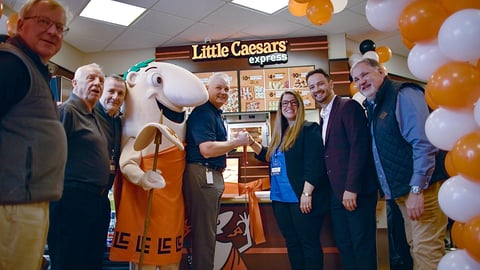
Take Little Caesars, the world’s third-largest pizza chain: it has partnered with BG Fuels-owned Waypoint Convenience in Ontario and North Sun Energy-owned Orangestore in the East Coast. (North Sun Energy also has a partnership with A&W.)
With more than 10 Express outlets inside c-stores nationwide so far, Chloe Battalia, managing director, Canada, for the pizza chain known for its Hot-N-Ready pizzas and Crazy Bread, is bullish on the channel.
“We see the model expanding rapidly,” she told CSNC at the launch of Orangestore’s first Little Caesars Express in September. “The synergy between our Express stores and the convenience sector really allows our business to thrive in smaller-town markets.”
“And for larger multi-unit operators that are iconic in their regions— like Orangestore—it allows them to align with another strong, recognized brand like Little Caesars that fits their existing real estate,” Battalia adds. “There are a lot of operators like Orangestore that can do that. Because when you look at costs and the strong sales we’re seeing here, it’s a win-win for everyone.”
This feature first ran in the November-December 2025 issue of Convenience Store News Canada.
BG Fuels-owned Waypoint Convenience opened its first Little Caesars Express inside a Mississauga, Ont. location in October 2024.
Thea Bourne, retail program manager at BG Fuels, says it has been a terrific success, particularly in getting Waypoint more exposure on third-party delivery apps, like DoorDash.
“A lot of people order pizza while on the go on their phone or from home, and so we’ve seen huge growth in terms of getting our products on the delivery apps,” says Bourne, since customers can place an order for pizza, as well as c-store products like chips and beverage alcohol. (The Mississauga location has a beer cave).
In September, Waypoint also began supporting school programs by providing Little Caesars pizzas for lunches.
“We’ve had five school signs up to pre-purchase pizza, and so that has been a really cool opportunity, and something that our retailer really drove,” says Bourne.
This year, BG Fuels also welcomed into its network two Pizza Pizza locations, with the acquisition of two c-gas sites, one in Marlborough, Ont. and the other in Edmundston, N.B.
“We didn’t bring in those franchises, so I’d call it organic expansion,” says Bourne, who says the company is now brainstorming options for 2026. “We’re hoping to do some interesting things with QSRs in the future, but have nothing baked enough to share yet.”
Clearly, a lot of c-store chains are just getting started.
This feature first appeared in the November-December issue of Convenience Store News Canada.