Nicotine's new frontier: 2026 Tobacco + Vaping Report

It's a public health success story: Fewer Canadians are smoking. But some government measures—high taxes and strict regulations—have had an unintended consequence: a thriving contraband market. Legal tobacco sales have plummeted far faster than smoking rates as a result, leaving the convenience channel to absorb steeper losses than expected while following the law.
According to data from NielsenIQ, cigarette sales fell 8.2% year over year in 2024, to $3.3 billion. Other tobacco products (non-combustible) dropped 10% from 2023, to $241.5 million.
In December 2025, Statistics Canada reported that the total number of cigarettes sold decreased 15.8% to 931 million compared with December 2024.
Fawwaz Mlatoom, owner of Mobile Convenience in Ottawa, says his sales “are down about 20% versus a year ago in every area of the category–vaping, cigarettes, all of it.” While he suspects the economy is playing a role in that pullback, recent news coverage has highlighted the scale of the illicit tobacco market.
In July 2025, Ontario Provincial Police seized 17,820 kilograms of contraband fine-cut tobacco valued at about $4.4 million after stopping a speeding big rig.

Last fall, Kelowna RCMP’s Crime Reduction Unit confiscated over 7,400 cartons of contraband cigarettes—1.5 million individual cigarettes—along with nicotine pouches and cannabis products during a home seizure. “The retail value of the contraband cigarettes alone is estimated to be in excess of $750,000,” the RCMP reported. The items were also found alongside cocaine and a firearm.
A 2024 EY Canada report commissioned by the Convenience Industry Council of Canada estimates that the illegal tobacco industry in Canada is worth about $1.3 billion.
“Canada’s contraband nicotine market has exploded into the Wild Wild West: a no-risk, high-reward free-for-all where bad actors are limited only by their imagination—and occasionally by a rare, small financial slap when caught,” says Jeff Brownlee, vice-president of communications and stakeholder relations, CICC.
“The real challenge today is the illicit market,” agrees Eric Gagnon, VP, corporate and regulatory affairs, Imperial Tobacco Canada. “Sellers operate without age‑verification, product standards and in direct unfair competition with responsible retailers who follow the rules.”
Gagnon notes the contraband market includes nicotine pouches, like its Health Canada‑approved nicotine‑replacement therapy Zonnic. “By removing its sale from convenience stores, the Government of Canada has unintentionally fuelled a booming illegal market for nicotine pouches,” he says.
Two provinces have taken action in trying to police it.
In 2025, Alberta introduced administrative penalties equal to three times the evaded tax on contraband tobacco, collectible directly from assets, property or income. Brownlee calls these penalties “game changing” and adds: “We also secured new mandatory reporting requirements to expose the market’s massive scale to law enforcement and governments.”
Ontario, meanwhile, has promised to strengthen fines and enforcement, such as supporting police with training for legally sound roadside searches of suspected contraband tobacco.
Looking ahead, the CICC is pushing for expanded powers and dedicated resources for municipal and provincial police, a crackdown on the e-commerce channel where Canadian youth can order illegal nicotine products online, and mandatory training for all nicotine retailers through its proven ID Please program.
“There’s zero standardized, government-mandated certification for selling age-restricted tobacco, vapes or pouches,” says Brownlee. “That’s a dangerous gap.”
The ID Please program would include a secure, real-time electronic database of certified staff, accessible to inspectors via mobile for instant compliance checks. “By requiring only certified personnel to handle sales, provinces can slash underage access, boost enforcement efficiency and rebuild consumer trust in a safer retail environment,” he says.
It would also position c-stores as active partners in government efforts, helping enforce the rules, protect consumers and fight back against contraband.

A bright spot in cigarette sales
Unlike Imperial Tobacco, JTI-Macdonald and Rothmans, Benson & Hedges, Century Tobacco Company (CTC) focuses squarely on selling cigarettes, under the brands Darts, Platinum, Rally and Bravo 1, without positioning itself as advancing for a smoke-free future or diversifying beyond traditional tobacco.
CSNC spoke to both c-stores and wholesalers who said CTC’s brands “are the one bright spot” for tobacco sales. As Steven Bouchard, national sales and marketing director, CTC, notes, c-stores can “effectively triple their profit per pack sold while simultaneously lowering overall inventory costs.
“Fewer stock-keeping units, competitive wholesale pricing and strong consumer uptake translate into faster turns and improved cash flow,” explains Bouchard.
While some large multinationals point to high taxation as driving some Canadian smokers to contraband, Bouchard highlights another factor: restrictive agreements that limit retailer flexibility—binding stores to specific floor pricing, narrow product selections and inflexible terms.
“In today’s tobacco and legal landscape, such practices raise serious questions and, in our view, approach the edge of what should be considered acceptable,” he says.
CTC is also leaning into the buy Canadian movement. “As a 100% private Canadian business, Century Tobacco Company offers something increasingly rare in this industry: products that are genuinely made in Canada, by Canadians, for the Canadian market,” says Bouchard, adding the company promotes its maple leaf roots on its website and other trade communications, emphasizing it manufactures its tobacco products from a 30,000-sq.-ft. manufacturing facility in eastern Ontario.

Up in smoke: a squandered cessation opportunity
In January, Health Canada released a progress report on the Canada Tobacco Strategy (CTS), a federal initiative launched in 2018 aimed at reducing tobacco use to less than 5% of Canadians by 2035. The report serves as a midway evaluation, showing both the progress achieved and the challenges that remain.
In 2024, only 13% of Canadians used a tobacco product—a steep drop from 29% in 2001. About 11% of adults reported smoking cigarettes, and roughly 300,000 Canadians who smoked in 2023 quit in 2024, representing around 8% of all smokers.
The report highlights a range of supports available to help smokers kick the habit, including counselling, prescription medicines and Health Canada–authorized nicotine replacement therapies (NRTs). However, more than half of successful quits in 2024 were achieved without formal supports, while NRTs such as nicotine gum and the flavoured nicotine pouch Zonnic accounted for about 25% of quits.
Health Canada also recognized the role of a legal vaping market in helping some adults transition from smoking. “While not an approved cessation therapy, approximately 21% of Canadians who quit smoking in 2024 said they used an e-cigarette to help them stop,” the report notes—a significant share.
Despite steady progress, the report warns that Canada is still on track to fall short of its 2035 target if current trends continue, leaving hundreds of thousands of Canadians still smoking.
Imperial Tobacco Canada seized on this conclusion—and Health Canada’s recognition of nicotine gum, vaping products and pouches as tools to help people quit—to stress the importance of getting reduced-risk products into smokers’ hands, including through convenience stores.
“Reducing the smoking rates down to roughly 11% over the last few decades was the easier part. The remaining smokers are harder to reach, more dependent, and more likely to face social, geographic and economic barriers to quitting,” says Eric Gagnon, VP, corporate and regulatory affairs, Imperial Tobacco Canada, in an op-ed shared with CSNC. “The final stretch to 2035 will require adaptation, not complacency.”
As he points out: “Health Canada, anti-smoking organizations, including Imperial, all agree that youth must absolutely be protected, smoking must continue to decline, and policies must be grounded in evidence. Where discussion is needed is on whether current approaches are fully supporting how adults actually quit. I would say we are missing that mark and the government agrees.”
This is where c-stores can play a role, not only in supplying reduced-risk nicotine products but helping educate smokers. “Canada needs a regulatory framework that protects youth, gives adult smokers access to authorized cessation products where they buy their cigarettes, and severely penalizes anyone selling illegal products,” Gagnon told CSNC in an email interview.
Fawwaz Mlatoom, owner of Mobile Convenience in Ottawa, says right now law prevents him from “offering a customer any tobacco asset.” That includes not only risk-reduced products, but also cheaper cigarette brands. “But if they ask, do you have something with less risk or something cheaper, we can make suggestions, but they have to ask first.”
Of course, even if they did, c-stores can’t offer products like Zonnic. Currently only sold in pharmacies, its manufacturer, Imperial Tobacco Canada, continues to advocate for the sale of nicotine pouches where cigarettes are sold.
While there was risk that nicotine gums could face the same federal restrictions as nicotine pouches, “measures have been more focused on newer formats,” says Shawhin Kanai, director of sales at Vancouver-based Sesh+Products. “Nicotine gum remains an established smoking-cessation format and continues to be available broadly at retail.”
Sesh+ has grown distribution over the past year to over 5,000 locations, from over 4,000, “which has translated to solid and consistent sales growth and strengthened brand recognition, particularly in the c-store and fuel retail channels as well as pharmacies.” (Sesh+’s lifetime sales are well north of $1 million.)
“Biggest opportunities include ongoing expansion in the c-store channel,” says Kanai, acknowledging he’d like to see staff be freer to make adult consumers more aware of Sesh+. “It can play a key role by making adult tobacco users aware of Sesh+ as an effective alternative available right on the shelf. Emphasizing the product’s benefits, flavour options and growing presence in stores helps encourage trial.”

-
Club and caffeine: Nuvona’s bold move
It’s been almost two years since National Smokeless Tobacco Company rebranded as Nuvona, reflecting its expansion beyond traditional tobacco. That growth includes the launch of nicotine-containing white pouch brand Club, as well as Proper Wild Energy shots—plant-based, non-nicotine beverages with organic caffeine.
The company also continues to offer its longstanding moist smokeless tobacco products, Copenhagen and Skoal. While Copenhagen and Skoal deliver the classic smokeless tobacco experience using traditional cured tobacco leaf, Club pouches are spit-free and discreet, containing finely ground tobacco and nicotine rather than whole leaf.
“Nuvona now reflects a modern distributor with a focused but diversified portfolio,” says Nuvona president JF Turcotte. “Our new portfolio demonstrates that we can execute across categories while maintaining strong compliance and customer service standards.”
He connected with CSNC to share insights into the company’s new identity and what lies ahead.
The rebrand marked a shift beyond smokeless tobacco. What does diversification look like for Nuvona?
Diversification for Nuvona reflects how adult tobacco and nicotine preferences are evolving. Traditional smokeless tobacco continues to serve a defined group of adult consumers. Club pouches give adult consumers looking for a modern white pouch a legal, compliant option available through established convenience retail channels. Smokeless products are not disappearing, but they are becoming a smaller part of a broader, more modern oral category.Some stakeholders see smokeless products as part of a harm-reduction continuum, while others remain skeptical. How does Nuvona position itself in that debate?
Tobacco products exist on a continuum of risk, with different products presenting different risk profiles. Nuvona’s role in the discussion has been to engage constructively at both the provincial and federal levels to ensure policymakers understand the science, and the real-world implications of regulation and enforcement.How is Nuvona helping retailers manage regulatory complexity while still growing the category?
Tobacco and nicotine fall within one of the most complex regulatory environments in Canada, and so retailers need certainty that the products they carry are compliant. Compliance is central to how Nuvona operates and a key differentiator for us in the market. We focus on products, packaging and labelling that align clearly with current rules, supported by compliance guidance to our customers. Our approach is to reduce regulatory risk and complexity for retailers by prioritizing compliance at every stage.What would success look like for Nuvona in Canada over the next three to five years?
Success would be remaining a trusted partner in a complex and evolving market. That includes maintaining leadership in smokeless tobacco, responsibly growing the Club brand of products, and thoughtfully expanding in non-nicotine categories like with Proper Wild energy shots. Ultimately, success is helping retailers bring more adult consumers into stores through well-performing, responsibly managed categories.

C-store IQ National Shopper Study: Nicotine Report
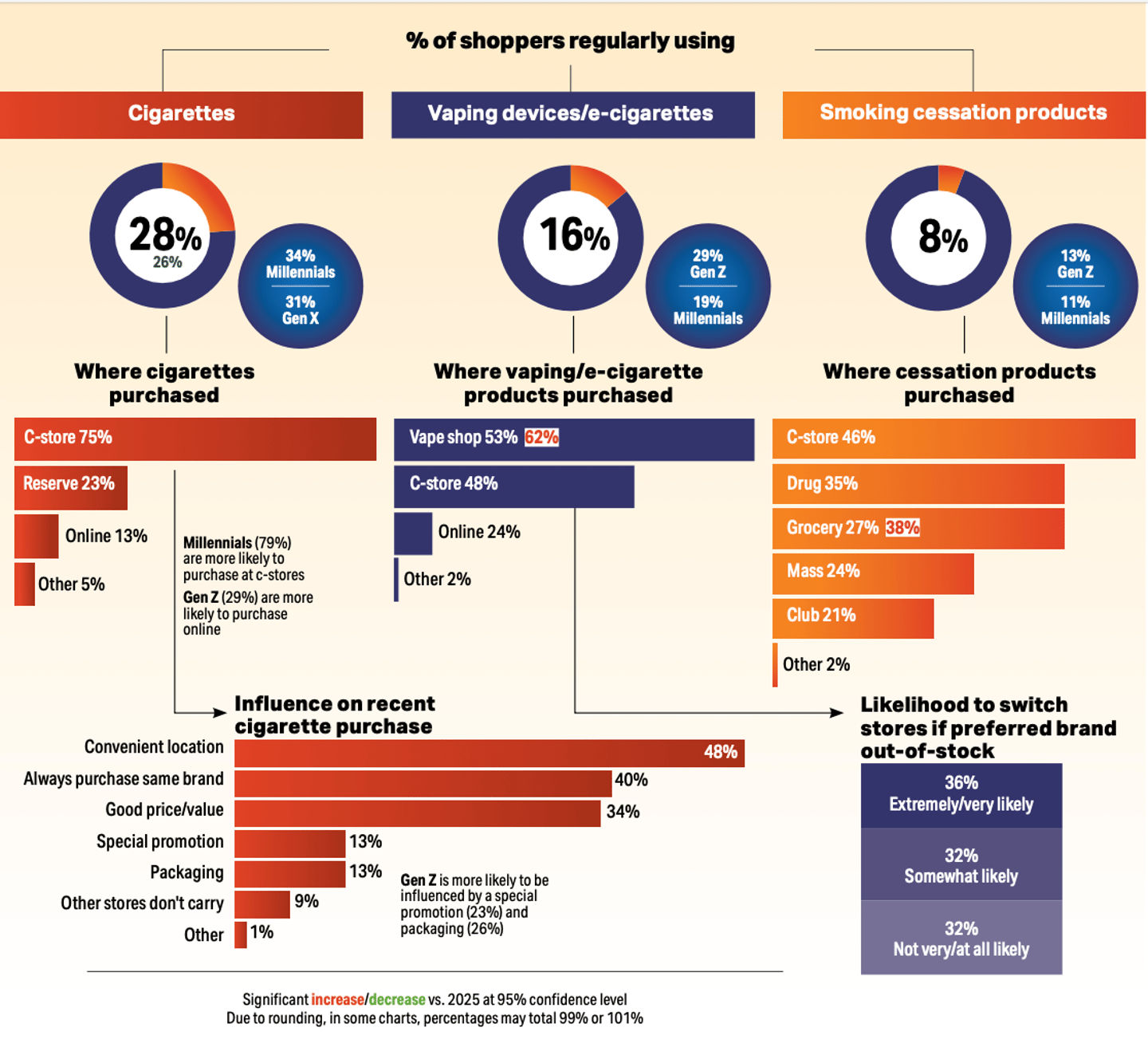
Cigarette use among convenience shoppers is up slightly year over year, and convenience stores remain the primary purchase destination for smokers, according to new data from the 2026 C-store IQ National Shopper Study, which surveyed more than 2,000 convenience and gas customers across Canada.
Three-quarters of smokers say they purchase cigarettes at convenience stores, reinforcing the channel’s central role in tobacco sales.
Millennials are playing an outsized role in cigarette purchasing. More than one-third (34%) say they smoke regularly, and 79% report buying cigarettes at convenience stores. The cohort also over-indexes on vaping and e-cigarette use, with 19% reporting regular use compared with the 16% overall average.
Generation Z, however, continues to drive the vaping subcategory. Nearly three in 10 gen Z shoppers (29%) say they use vaping or e-cigarette products regularly.
The data also suggests a shift in where consumers are buying these products. Fewer users report purchasing from specialty vape shops, down nine percentage points year over year to 53%, narrowing the gap with convenience stores and signalling a growing opportunity for the channel.
Brand loyalty remains strong across both cigarette and vape users. More than one-third of users (36%) say they are likely to switch stores if their preferred brand is unavailable. That figure rises to 43% among millennials, underscoring the importance of in-stock execution and assortment discipline.