Tim Hortons tweaking English muffins, espresso and beverage machinery: president
Perceptive Tim Hortons guests might soon notice a few changes at the café chain.
The company is rolling out an improved English muffin, adding fountain drink machines to some restaurants and debuting new espresso equipment, president Axel Schwan said Thursday.
While he thought Tims already had a "great" English muffin, he told The Canadian Press his company wanted to tweak the vessel for many of its breakfast sandwiches "to make it even fluffier and even more enjoyable to eat."
By the end of this week, the new muffin will have launched in Western Canada and by the end of the quarter, it will be in all restaurants across the country.
It shows you that we are really fully, fully focused. . . on guest feedback and then, we keep improving the core in addition to innovating," he said.
The changes to the English muffin come on the heels of improvements to several other Tims staples. Last year, its chocolate chunk cookies were made bigger and pumped with more chocolate to boost its ooey gooey factor. The company has also added more fruit to its apple fritters and more filling to its Boston Cream doughnut.
These kinds of tweaks don't just hearken to the "back to basics" strategy Schwan launched after becoming Tims Canada and U.S.'s president in 2019, but also show how the company is trying to push itself forward in an ultra-competitive market where customers are feeling squeezed.
In recent years, Tims started taking on most big fast-food players by launching wraps, rice-based bowls and flatbread pizzas to grow sales in the afternoon and evening.
It also edged into Starbucks' territory with more inventive and trendy beverages. It now sells energy drinks and beverages boosted with protein or made with carbonated bases or cold foam.
Cold beverages
In its latest quarter, cold beverages made up 27% of the company's total drink sales. They grew 8.6% despite colder than usual temperatures in December.
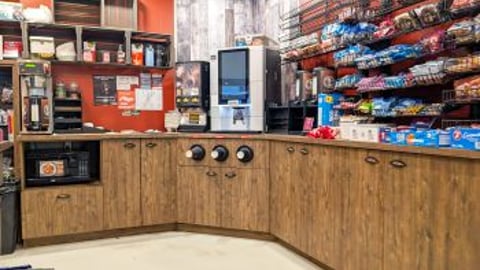
New espresso and fountain drink machines stand to fuel even more growth.
The espresso machine took years to develop but is much faster than Tims' previous equipment, Schwan said.
"Think of it like this: better quality product, better tasting product that we can deliver faster," he said.
So far, it's in about 10% of the company's restaurants but as locations get remodelled and the older machines age, it will become a standard across the brand.
The fountain machines are an even newer development Tims has been working on with Coca-Cola.
They haven't hit every store yet, but the machines are a way to drive more combo sales and they "play a key role" with many of the other cold beverages the brand has been exploring, he said.
Schwan's remarks came after RBI, the company that owns Tims, Burger King, Popeyes and Firehouse Subs, revealed its fourth-quarter profit fell compared with a year ago but its revenue rose.
RBI, which keeps its books in U.S. dollars, said its profit attributable to common shareholders amounted to US$113 million or 34 cents US per diluted share for the quarter ended Dec. 31. The result compared with a profit of US$259 million or 79 cents US per diluted share in the last three months of 2024.
On an adjusted basis, RBI says it earned 96 cents US per diluted share, up from an adjusted profit of 81 cents US per diluted share a year earlier.
Revenue for the quarter totalled US$2.47 billion, up from US$2.30 billion in the fourth quarter of 2024, while system-wide sales amounted to US$12.13 billion, up from US$11.28 billion.
Some segments of the company, especially Burger King, were hampered by higher beef prices that have come from depleted U.S. cattle herds.
Coffee costs
Others grappled with higher coffee costs—the result of extreme weather events in coffee-growing countries and tariff uncertainty.
Tims doesn't have many beef products, so the rising meat costs "are not playing a big role" at the chain, but it raised coffee prices an average of three cents per cup last year, marking the first time in about three years that it adjusted the price of coffee.
On Thursday, Schwan said the company was starting to see relief. Coffee costs have "come down significantly" in recent months, he said.
Patrick Doyle, RBI's executive chairman, said on a Thursday earnings call that the company has handled the headwinds well.
Its comparable sales in Canada grew 2.8% in the last quarter, outperforming the broader Canadian quick-serve restaurant industry by nearly two points.
Overall, he said last year was "demanding" for restaurant operators, when you consider the rising costs and how the geopolitical uncertainty of U.S. President Donald Trump's tariff war weighed on the business and consumers alike.
"Taken together, it was the kind of environment that serves as a pretty good test of the fundamentals of a restaurant business," Doyle said.
"And in that context, our performance demonstrated that the underlying fundamentals of our portfolio are not only resilient but improving."