The new leadership triangle: Belief, builder and bonds

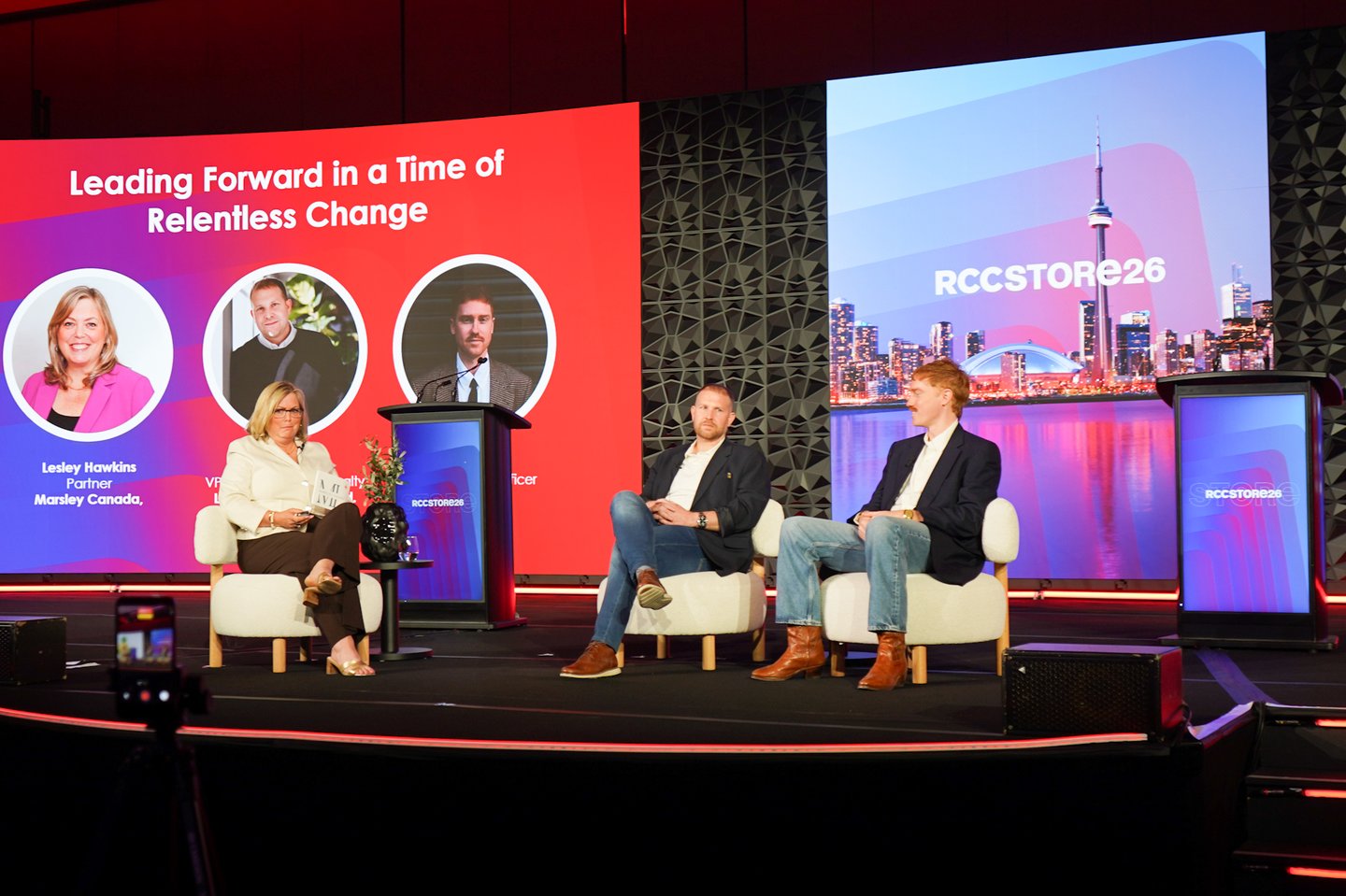
At the RCC Store 26 conference on Wednesday, June 3, experts shared leadership lessons in a round table discussion called, “Leading Forward in a Time of Relentless Change.” Moderated by Lesley Hawkins, partner at Marsley Canada, the panel looked at the what resilience means in the workplace, and how to build a team that is ready for any crisis that might come its way. Phil Higdon of Saje Natural Wellness and Noah Goldberg of Loblaw Companies Limited discussed the “Three Bs of resilience: Belief, building, and bonds.”
Goldberg said that he builds his leadership skills on his past experiences. "We've all had that past role where we were not supported." It is important to remember the bad as well as the good in order to get some perspective on current situations, as well as learning from past crises. He always gleans information from former colleagues and current leaders. "There's tidbits that I've taken; those have been building blocks to what I call my house of leadership. It's all about learning from others."
Higdon, the chief people officer for Saje Natural Wellness feels that resilience has become a buzzword often used as a compensation for lack of clarity and disorganization. He emphasized the importance of distinguishing between a healthy, resilient environment and one where teams are seen as “shock absorbers” for poor leadership.
“When I think about resilience, it's the ability for somebody, or a team, to be able to bounce back after an ouch. To be able to be handed a curve ball and think about how to work through this, or what would it take to get to where we need to go, and that's the kind of person really what we want to be hiring, it's what we want to be promoting. It's what we want to be cultivating within the team.”
“Really the role of leadership and the role that I try to play is one of context-setting and sense-making for the team.”
During corporate changes, Higdon insists it is not enough to say a change is a good idea. The incentive is only a part of it: Making it a practice to explicitly tell the team what is in the change for them to really moves a group forward in any new initiative.
“I think helps to create that contextual red thread of ‘this is what's in it for me,’ ‘this is how I need to show up in this,’ but it all comes back to bringing the team through the organization through the story and the context, and not seeing this as a job to be done on one day.”
Belief sits at the top of triangle
Higdon insists he learned much of corporate team building from trial and error. Employees should have belief in the company and the product(s), he shares. Having a genuine connection to the brand is key to building a successful brand. “Obviously it's irreplaceable, you can't train it, you can't really performance-manage somebody into belief, it's something that somebody needs to bring to work every day.”
The energy of people who love and trust a brand is almost palpable, according to Higdon. The power of emotional connection to a product creates better products and better service, he adds. Employees who understand the customer provide better customer service because they are customers themselves.
“When you walk into a room and you have a room full of people who are customers and are working on a problem, you can feel the energy in the room; the creativity that flows thorough that room is like nothing else. In the past, when I’ve walked into a room and not felt that energy, I’ve left worried. I come back that belief is a large stake we’re looking at when bringing new people into the organization.”
Hiring for the builder mindset
Operating in a high-performance environment is stressful, he concedes. And as Saje Natural Wellness is a mid-sized company, ensuring that staff are equally vested in the company is key. Higdon doesn’t refer to mere company loyalty, he is speaking of building teams and working on problem solving as a team.
“When we're looking at what it takes to build the optimal team at what it takes to make performance really resilient in the face of change, the more people that we have really are builders, the stronger we know we're going to be.”
“You can hire somebody who is entrepreneurial, and wants to change the world,” says Higdon, “but if they don't feel that investment in themselves, and if there's no connective tissue relationally between themselves and their leader, or themselves and their team. The curve balls start to weigh up.”
The choice and power that managers and executives have is to build bonds between people and know that it will serve everyone well when the unexpected comes along. However, strong belief without connection is not enough. Even the strongest “builders” without relationships can struggle under pressure.
Goldbergs adds that attitude is only a small facet of high performance. "If you have a high performing athlete, you'll think, they're well paid, so you think they are supported. But support comes in so many different shapes and sizes.Yeah, they're well paid, but the smallest of details is like, the cafeteria at their home arena: is it nutritious? It's the coaching staff there that understand all the importance of those details, you know it doesn't just come naturally."
Bonds are the glue that matter most
The unexpected in business can be the most stressful in any venture, and building an emotional bond between people is an investment that pays off, adds Higdon. “Every minute of the day that we decide to check in on somebody to hear about how their work is going, how their life is going to show a general, genuine interest in somebody is like deposit into a bank account.
“When times get tough, or when there’s a curveball and you need to call somebody at 7o'clock at night, because something's hit the fan, you’ll need some money to make an investment, or to make a withdrawal; You can hire somebody, or have a team member who believes in the company to help you.”
Resilient performance is not a one-time event: Belief creates purpose, builders create momentum and bonds create staying power. Together, they form a foundation for resilient performance.