

Scaling new heights


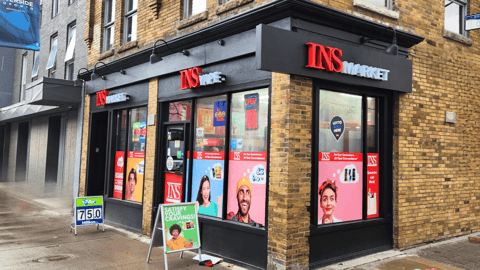
From downtown officetowers and Toronto’s PATH system to hospitals, universities and bustling street-front neighbourhoods, INS Market is increasingly hard to miss. The franchised convenience store chain operates 110 locations across Canada, with 50 more planned this year. Growth is supported by new transit partnerships, including Calgary Transit, and flexible store formats.
Those formats run the gamut, from compact kiosks under 100 sq. ft.—the smallest, at just 57 sq. ft., is tucked beneath a staircase in Toronto’s Hudson’s Bay Centre at Yonge and Bloor—to a sprawling 2,500-sq.-ft. store in Streetsville, Mississauga, Ont., which opened last year as the brand’s largest location to date.
As of press time, the Canadian-owned and operated company had new stores under construction at Ajax GO Station and York University, and outside the Greater Toronto Area in cities from Halifax and Ottawa to Winnipeg, Calgary and Vancouver.
A newly announced national distribution partnership with Sobeys is also reshaping the business, giving INS Market faster replenishment from coast to coast and access to a broader grocery and fresh assortment.
For a franchisor scaling at this pace, it’s notable that INS Market’s head office numbers just 10 people. At the company’s bright, modern headquarters on Toronto’s Queens Quay near Lake Ontario, CSNC sat down with two employees of that lean team: Michele Lown, senior vice-president, and Amedeo Christian Catenaro, senior director of franchising, real estate and marketing, to discuss how the company manages rapid growth, supports franchisees and navigates product innovation across its expanding network.
Lown is tenured, celebrating her 23rd year with INS in 2026. “There are others on the team who’ve been with us 10, 15 years,” she notes. Catenaro, now in his third year with the company, represents newer blood, recruited from a real estate firm located down the hall. “I kept running into Michele and Tiina Kamagianis, director of training and onboarding, in the elevator. They called me the ‘elevator guy’ for about a year before I officially joined the team,” he recalls with a laugh.
INS’s culture is hands-on and team-driven, rooted in a fully in-office model—no hybrid work here. Knowledge flows both ways: seasoned leaders share hard-earned expertise, while newer hires bring fresh thinking. Conversations move quickly across merchandising, operations, real estate and franchise support. “Decisions are made within minutes,” says Lown. “If a store has a challenge, we get in a room and solve it—no waiting for Zoom calls to be set up or 16 layers of approvals.”
“It also helps that we genuinely like each other,” she adds, describing a collaborative philosophy that extends beyond the office. Some employees head together to the rock-climbing gym just downstairs after work. The parallel fits: the team is scaling thoughtfully, relying on trust, communication and deliberate moves rather than speed alone.
From magazines to Market
INS Market is owned by The Davis Group of Companies—which also operates the Kindling Cannabis retail dispensaries in southwestern Ontario—and was originally created by CEO Sam Davis as International News in 1994, at a time when print media drove daily foot traffic. “It was magazines, magazines, magazines,” recalls Lown. “‘Where’s your People magazine?’ If you didn’t have People, you weren’t doing business that day.”
At its peak in 2014, International News had roughly 200 locations nationwide, with some dedicating more than 16 feet of wall space to print media.
But as consumer habits shifted online, the retailer shrank its store count, streamlined operations and overhauled its merchandise mix. Rebranded as INS Market in 2017, the reset laid the foundation for the urban convenience concept now in expansion mode, with Davis stepping back from day-to-day operations.
INS Market first had to survive the pandemic, however. “Obviously, things happen—COVID hit, and we had to shrink a little more,” says Lown. “But last year we started ramping back up. And this year is going to be tremendous.”
Game-changing partnerships
INS Market’s partnership with Sobeys Wholesale is transforming operations. “It’s allowing us to carry a broader grocery assortment, including more fresh items and even dairy,” says Lown. “Their team is incredibly collaborative—we meet weekly and are always asking, ‘What can we do to support you? How can we help?’”
Sobeys Wholesale, as a coast-to-coast wholesale distributor across Canada, has dramatically shortened delivery times. “Orders that once took seven to 10 days can now reach our stores within 24 hours, whether in Alberta, B.C., Nova Scotia, Manitoba or Quebec—it doesn’t matter,” says Lown.
That has been a “game changer” for national growth. “Before, you might build a store in Alberta, plan deliveries seven to 10 days out, and then a snowstorm hits—leaving your merchandise team on the ground with no product,” she explains. “This partnership lets us move faster and operate much more efficiently.”
Zakir Hossain, a franchisee since 2003 when the banner was International News, now runs five INS Market stores in Toronto, including his original Harbourfront location and one in Scotiabank Arena. He says the partnership with Sobeys Wholesale is a major upgrade from the supplier used after COVID.
“We struggled a lot with that supplier,” says Hossain. “This is a good move. The product is fresh and high quality, and the pricing is more competitive than with the previous vendor.” While the partnership is still in its early days, Hossain says he plans to “experiment with the product selection from Sobeys because I believe they’re the right vendor for us.”
INS Market is also driving traffic through other partnerships, such as LCBO and PepsiCo, as well as its Frito-Lay division, and is in the midst of preparing a major collaboration with Coca-Cola for the 2026 FIFA World Cup, which Canada will co-host alongside the U.S. and Mexico. Thirteen games will be played in Toronto and Vancouver from June 11 to July 19.
“We have a lot of locations in those cores, and some very exciting initiatives planned for World Cup festivities,” says Catenaro. “It’s really our franchisees’ interpersonal skills and customer service that shine—especially in hospitals, transit hubs and vibrant communities. Initiatives like this with our partners help drive growth, engage consumers and bring them back into stores for repeat visits.”
Franchise-first, big ambitions
Despite its small head office, INS Market punches above its weight. “We’re not afraid to take on major initiatives,” says Catenaro. The company has deliberately chosen to remain a franchise-only business. “We’ve tried corporate-owned stores in the past. It’s not what we want to do,” Lown says, emphasizing the focus on empowering franchisees.
The staff count is growing, with the recent hire of a new franchise manager. But as Lown notes, success is less about size than fit. “We’ve had expansions and contractions, but having the right people—whether it’s 100 or 15—is what counts. And the team we have now just gels together.”
- SMALL TEAM, SMART TECH
Alongside an all-in team philosophy, INS Market taps tech and data to punch above its weight.
Planogram punch
Using VisualTouch, a Vaughan, Ont.–based POS system, INS Market analyzes sales data and tailors offerings by location.
This precision is crucial as two categories—foodservice and grocery via Sobeys Wholesale, plus beverage alcohol—expand. In Ontario, home to about 80 of 110 stores, all locations now carry beverage alcohol excluding sensitive sites, such as campuses and hospitals. Franchisees who secured licenses early reported traffic gains of 20% to 30%.
Planograms are shared via QR codes. “Everything is built in two-foot sections,” says vice-president Michele Lown. “We focus on top sellers. A 400-sq.-ft, store gets the essentials, while a 600-sq.-ft. location gets the full lineup.”
Prime real estate
INS Market has added a new tech layer to support expansion: CoStar, a commercial real estate platform that tracks leasing trends, upcoming listings, and informs site-selection decisions.
“We’ve been introducing tech steadily over the past few months to drive growth,” says Amedeo Christian Catenaro, senior director of franchising, real estate, and marketing. “Platforms like CoStar help us identify prime locations and act quickly when opportunities arise.”Learning on the go
A new mobile-first learning management system (LMS) is in the works that aims to modernize franchise training, replacing static manuals and one-time training sessions with on-demand, continuous learning for new and existing franchisees.
“The LMS centralizes operational guides, brand standards, product updates and best practices,” says Catenaro, “while giving franchisees the flexibility to learn at their own pace.” Content will be refreshed in real time, allowing INS Market to roll out new initiatives, procedural changes or promotions without version-control issues.
Eye on the store
The head office has centralized access to a network-wide CCTV system, providing continuous, high-resolution coverage across all stores. Remote access to live and recorded feeds lets the operations team assess incidents, respond to safety concerns and support franchisees in real time.
The system also tracks customer behaviour—traffic patterns, dwell times and movement flow—to help improve the shopping experience. Footage is stored via DVR for loss prevention, incident review, training and compliance. It also supports the responsible sale of beer and wine, ensuring adherence to age-verification rules, regulated hours and checkout procedures, especially during high-traffic periods.
Related Content

Originally published in the May/June issue of Convenience Store News Canada.