Tim Hortons revenue gains driven by commodity prices in Q2

Restaurant Brands International Inc. (RBI) reported over 3% global comparable sales growth and double-digit earnings growth for the second quarter ended June 30, 2026. Standout performance from Burger King and sustained strength in its international operations drove the quarterly gains.
"We built on our strong start to 2026 with another quarter of over 3% global comparable sales and double-digit earnings growth, led by Burger King's standout performance and continued strength at International," said Josh Kobza, chief executive officer of RBI. "These results show the benefits of our diversified portfolio and that the strategy we outlined at Investor Day is working."
Second quarter consolidated financial highlights
During the second quarter of 2026, RBI achieved system-wide sales growth of 6.4% on a constant currency basis, up from 5.3% in the same period last year, pushing total system-wide sales to $12,702 million compared to $11,853 million in Q2 2025. Global comparable sales rose 3.8%, accelerating from 2.4% year-over-year. Net restaurant growth held steady at 2.9%, expanding the company's global footprint to 33,156 system restaurants at period end.
Consolidated total revenues grew to $2,520 million, up from $2,410 million in the second quarter of 2025. Operating income surged 48.4% to $716 million, while net income from continuing operations increased to $665 million, up from $264 million a year earlier. Diluted earnings per share from continuing operations reached $1.45, compared to $0.58 in Q2 2025. On an adjusted basis, operating income reached $715 million, reflecting 6.7% organic growth, while adjusted EBITDA climbed to $810 million. Adjusted diluted earnings per share expanded 12.9% nominally—or 12.3% organically—to $1.07, and net leverage improved to 4.1x.
Segment performance breakdown
Tim Hortons
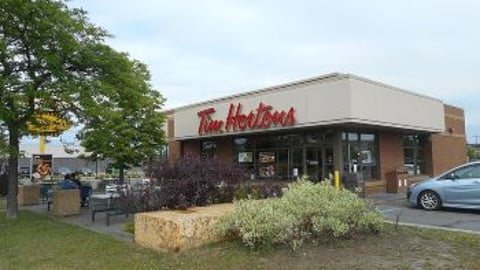
Tim Hortons generated system-wide sales of $2,003 million for the quarter, representing system-wide sales growth of 0.4%. Comparable sales saw a modest gain of 0.1% overall and 0.1% in Canada. Total revenues for the brand rose to $1,137 million from $1,083 million in Q2 2025, while adjusted operating income increased to $287 million from $278 million. Revenue growth was primarily driven by higher supply chain sales resulting from elevated commodity prices and consumer packaged goods (CPG) net sales. However, adjusted operating income growth was partially offset by increased supply chain cost of sales due to those same commodity cost pressures. Tim Hortons ended the period with 4,570 system locations.
Burger King
Burger King delivered standout operational growth, recording system-wide sales of $3,193 million on 8.2% system-wide sales growth. Comparable sales jumped 8.6% globally and 8.5% in the US. Total segment revenues reached $397 million, up from $388 million in the prior-year period, driven by the strong comparable sales growth despite the net impact of refranchisings. Higher franchise and property revenues pushed adjusted operating income up to $137 million, compared to $121 million in Q2 2025. The brand continued to execute its multi-year "Reclaim the Flame" strategy, funding $194 million of its planned $550 million "Royal Reset" capital allocation for remodels, relocations, technology updates and kitchen equipment enhancements as of June 30, 2026. Burger King closed the quarter with 6,992 restaurants worldwide.
Popeyes
Popeyes experienced sales headwinds during the second quarter, with system-wide sales falling 3.1% to $1,529 million. Comparable sales decreased 5.1% globally and 5.2% in the US market. Total segment revenues declined to $199 million from $210 million in Q2 2025, while adjusted operating income dropped to $63 million from $66 million, with both figures directly impacted by the reduction in comparable sales. The brand ended the quarter with 3,542 active locations.
Firehouse Subs
Firehouse Subs maintained positive trajectory, delivering $361 million in system-wide sales, which represents 7.5% system-wide sales growth. Comparable sales edged up 0.4% globally and 0.7% in the US. Total revenues expanded to $62 million from $59 million in Q2 2025, and adjusted operating income rose to $17 million from $15 million. Overall financial gains were driven primarily by unit growth, as net restaurant count expanded 8.1% year-over-year to reach 1,482 restaurants.
International
RBI's International segment posted strong top-line numbers, delivering system-wide sales of $5,616 million on 10.7% system-wide sales growth. Segment comparable sales grew 5.5%, supported by a 5.4% comparable sales increase at international Burger King locations. Total revenues climbed to $274 million from $250 million in Q2 2025, and adjusted operating income reached $194 million compared to $172 million a year prior. Growth was propelled by higher royalty revenues from Burger King and Popeyes, alongside the resumption of royalty collections from Burger King China. Foreign exchange tailwinds added $4 million to revenues and $2 million to adjusted operating income, though higher corporate compensation costs partially offset operating gains. The international footprint ended the period at 16,570 restaurants.
READ: Restaurant Brands International reports Q1 profit and revenue up from year ago
Restaurant holdings
The restaurant holdings segment reported system-wide sales of $506 million, consisting of $493 million from US Burger King locations and $13 million from international operations. Segment comparable sales rose 9.0% overall and 9.2% for US Burger King units. Total revenues rose to $506 million from $469 million in Q2 2025, supported by US Burger King sales gains and additional Popeyes China store openings, despite US re-franchising activity. Adjusted operating income remained relatively flat at $17 million, as revenue growth was offset by higher company restaurant expenses, depreciation and amortization, and costs required to scale international start-up operations. The segment held 1,104 restaurants at the end of the quarter, including 994 US Burger King sites and 110 international units.
Corporate updates and strategic capital allocation
RBI executed key operational reorganizations and capital allocation moves during the period. On January 30, 2026, the company established a joint venture with CPE Alder Investment Limited for Burger King China operations, with CPE contributing $350 million in primary capital. RBI deconsolidated BK China, retains a 17% equity interest accounted for under the equity method, and now records franchise royalty revenue in the International segment.
Regarding capital returns, RBI repurchased 1,821,167 common shares for $137 million during the second quarter. Between July 1 and July 31, 2026, the company repurchased an additional 463,385 common shares for $35 million, leaving $794 million remaining under its $1,000 million share repurchase authorization. Additionally, the Board of Directors declared a quarterly dividend of $0.65 per common share and partnership exchangeable unit of RBI LP, payable on October 2, 2026 to shareholders of record as of September 18, 2026.
2026 outlook and long-term targets
RBI reaffirmed its financial targets for the full year 2026. Non-rh segment general and administrative expenses are expected between $600 million and $620 million, while restaurant holdings adjusted operating income is projected at $10 million to $20 million. Adjusted net interest expense is targeted between $500 million and $520 million, with total capital expenditures and cash inducements estimated around $400 million.
Looking further ahead, the company continues to project average annual performance from 2024 through 2028 of at least 3% comparable sales growth and 8% or more organic adjusted operating income growth. RBI also expects net restaurant growth to reach 5% or more toward the end of this algorithm period.