Beverage alcohol: A year in review

On September 5, 2024, the Province of Ontario turned on the taps, allowing convenience stores across the province to sell beer, wine, cider and ready-to-drink products. What a year it’s been! Welcome to the first in an exclusive month-long series of articles and interviews with stakeholders and leaders, who share learnings, insights, how far we’ve come and what still needs to happen to make the most of this valuable category in convenience.
The numbers are in! Nearly a year in, beverage alcohol sales at Ontario c‑stores are outpacing projections, according to regional chains and independents that shared figures with CSNC.
Since the province’s Sept. 5 expansion last year allowing c‑stores to sell beer, wine and RTDs, many operators say the new category has been “a lifeline:” pulling in new shoppers and prompting stores to overhaul footprints, tighten adjacencies and test fresh merchandising ideas, from dedicated display islands to walk‑in coolers.
The rollout hasn’t been without challenges, from carving out floor and storage space to determining which brands and SKUs to stock. But the biggest frustration has been with LCBO’s Grocery Management System (GMS), the online portal retailers use to place orders. Many say those issues are to be expected as the provincial alcohol agency scales up its role as a wholesaler as well as a retailer. C-store execs and owners expect improvements in year two.
CSNC spoke with operators across Ontario to uncover what’s working, what’s not and where the next phase of growth might be.

Expectations exceeded
Marietta Cini, vice‑president of operations and sales at Hasty Market Corp., says the opening of the category came just in time. “Beverage alcohol has revived the entire industry,” she says. “Without beer and alcohol, a lot of stores this year would have shut down.”
That rebound matters because the sector’s two traditional top categories—tobacco and lottery—continue to decline, while consumer spending is being pinched by higher prices, rising interest rates and trade‑related tariffs.
After a phased rollout, nearly all Hasty’s roughly 130 stores now carry beverage alcohol, except for a handful of owners who opted out for religious reasons—an accommodation the company was happy to provide.
Some Hasty locations are now ringing up $10,000 to $20,000 in beer, RTDs and wine sales each week, while its new neighbourhood concept, The Market On, is seeing basket sizes rise as customers add beverages to freshly prepared meals‑to‑go.
And Hasty isn’t alone in toasting success.

BG Fuels, which operates 80 Waypoint Convenience stores across Ontario including two LCBO outlet locations, has also found beverage alcohol to be a growth engine. Category manager Sarayu Kandregula says sales have exceeded projections, with summer bringing a sharper‑than‑expected spike.
READ: BG Fuels takes all-in approach to selling beverage alcohol at Waypoint Convenience sites
“The results overall have been fantastic,” Kandregula says. “Education was needed early on for both retailers and consumers, and while there’s still work to do, the momentum is exciting.”
Making room for growth
Space constraints were an early hurdle. About half of Waypoint’s Ontario stores are kiosks averaging under 500 sq. ft., with just two to four cooler doors. “And given legacy agreements with non‑alcoholic beverage suppliers, we needed to make sure they were happy,” Kandregula says.
Initially, only about 20% of cooler space was devoted to alcohol, with an emphasis on single‑serve options. But strong sales quickly justified expansion. “Today, we take a data‑driven approach, guided by store‑specific insights, and allocate up to one full cooler door—roughly 50%—to alcohol in locations where performance warrants it,” she says. “We were initially heavy on single cans, but now six‑packs alongside single‑serve formats are top performers.”
Waypoint is also building larger footprints in new stores to accommodate the category. Case in point: a 3,000‑sq.‑ft. Haliburton location features a walk‑in storage area stacked with beer cases, a grab‑and‑go cooler at checkout, and rows of shelving for wine and RTDs. It celebrated its grand opening in August.

At Pinto’s Convenience in London, Ont., “the category has overtaken everything and is our top‑selling category now,” says owner Pinto Sood, who had high expectations for beverage alcohol a year ago.
With some weeks topping $6,000 in sales, performance has been strong enough that Sood is considering expanding the store’s footprint—possible because he owns the building. For now, he’s rented a shipping container to hold excess inventory that can be sourced to replenish fast‑moving products between weekly deliveries.
READ: Independent operators share plans for beverage alcohol sales
Fine-tuning selection
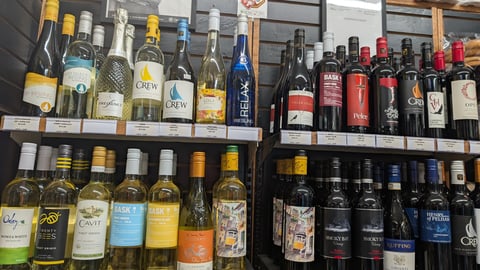
With no channel-specific benchmarks, many c-stores had to experiment to find the right mix for customers—all while following Ontario’s regulatory rules, which require at least 20% of beer, cider, and RTDs, and 10% of wine, to come from small local producers.
At Pinto’s, beer accounts for about 60% of sales, RTDs around 30% and wine about 10%. “Everything sells and so we’ve been really happy with all three categories,” says Sood.
At Waypoint, beer is even more dominant, representing about 90% of beverage alcohol sales—with value brands leading growth. “Labatt Blue, Busch, and Laker have gained solid traction across our network,” says Kandregula. “Suppliers were pushing premium, but convenience shoppers aren’t looking for that yet. Premium may come eventually, just not today.”
With the category’s strong reception, Hasty Market’s Cini says operators are also rethinking their product mixes beyond beverage alcohol.
“There has been a shift to, ‘How do I keep those customers coming in, not only for alcohol but other items?’ And that is why we’re seeing some of our competitors, like Quickie, renovating with a new store concept and adding more categories,” she explains. “The store refreshes happening are about redefining what a convenience store is.”

Ordering headaches
GMS friction has been one of the biggest pain-points. The Grocery Management System, the LCBO’s online ordering portal that supports more than 4,500 grocery and convenience customers, has prompted frequent complaints from licensed operators.
Earlier this year, the LCBO told CSNC it is working “to improve the ordering experience for convenience stores and grocers,” including “improvements to the interface for our B2B returns and claims submissions.”
CSNC will share more details from the provincial agency soon.
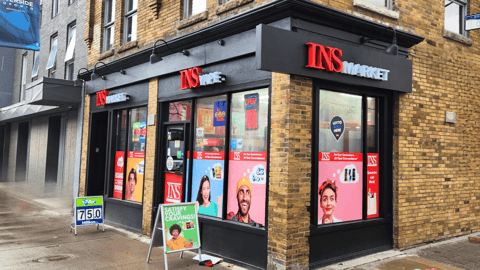
“The order portal feels outdated,” says Amedeo Catenaro, director of marketing and category manager for beer and wine at INS Market, which is expanding alcohol to all its Ontario locations. (link to their news story, not yet published). “It's difficult to file claims for missing or damaged products. We've had challenges obtaining refunds for some of our stores.”
READ: Most new INS Market stores in Ontario to stock beverage alcohol

Small independents say the system creates unnecessary headaches and wastes valuable time.
Ure’s Country Kitchen in Harrow, Ont. has heavily invested in the category. (link to standalone story) Laurie Ure, who runs the store, restaurant and miniature-golf course destination with her husband Randy, recalls placing an order for 26 cases only to learn that the LCBO warehouse had 13 available. Because the portal requires at least 15 LCBO‑supplied cases to qualify for delivery, her order fell short—but the website never flagged it.
READ: Ure’s Country Kitchen has found success in Ontario's expanded beverage alcohol market
“Why can’t the system warn me?” she says. “Instead, I was told to drive 30 kilometres to Windsor to pick it up. If the website had simply flagged that I was two cases short, I would’ve added them and had the whole order delivered.”
August Guo, who with his wife Cathy Xu owns Carp Foodliner in a village outside Ottawa, describes a similar problem. He ordered 30 cases but received only 15 after one brand was out of stock—and was billed the higher delivery rate for the smaller shipment. “Whatever I pay, the rate has to follow my order, not the shipment,” he says. “If you don’t have the item I ordered. you need to flag it or remove it from the system.”
READ: Convenience stores, LCBO navigate growing pains with roll out of beverage alcohol
Guo says his store averages about $3,500 a month in beer and wine sales, but extra costs like these eat into already thin margins. After factoring in insurance, licensing fees, and modest profit on each sale, the category barely breaks even and showed no growth over the past few months.
“My sales this summer are almost the same as in the winter,” Guo says, adding that with an LCBO outlet just 300 ft. away, competing on price is nearly impossible.
This kicks off a series of Beverage Alcohol: Year in Review articles. Subscribe Here to the All Convenience newsletter today an get the articles delivered straight to your inbox every Monday and Wednesday.
If you have a story to share, please reach out to the editorial team.