Water wise


Car wash and auto detailing bring in $1.7 billion annually, and the sector is expected to grow 9.4% in 2026, according to a recent Ibis World report. However, automated car wash tunnels use up to 450 litres of water per vehicle. Rising water and sewer costs are driving innovation in the commercial car wash space as operators lean towards efficiency, sustainability and profitability.
Over the past decade, there have been advancements in water reclamation systems, including UV disinfection, ozone treatment, advanced filtration and gravity settling tanks to separate solid particles from water.
Water reclamation technology reduces water consumption while also lowering operating costs and mitigating waste. Plus, it’s a great way to promote your car wash facility as eco-friendly.
While older systems could only recycle about half the water being used, today’s systems can reduce freshwater consumption by 90 to 98%. It’s impossible to reclaim 100% of car wash water.
“That’s because when a car is going through a car wash, there’s evaporation of water in the system, and carry-off from the vehicle that drives through even though the blowers blow a bunch of the water off,” explains Russ Blanco of Winnipeg-based Point Blanc Agency, the Canadian distributor for Vortex CHC.
Here are some common pain points and what to consider when upgrading or installing a water reclamation system.
Retrofitting can be challenging
The growing focus on water reclaim in the car wash industry is also due to government regulations in many regions across North America, notes Mack Ewing, senior director of sales and marketing for OPW Vehicle Wash Solutions.
“The modern car wash is very efficient but still uses a lot of water—which is getting more expensive every year, so reclaim is critical,” says Ewing.
“One of the biggest challenges with reclaim systems is that they can be very difficult to install into existing car washes because they’re often large systems that require settling tanks that go underground, which is a significant project that requires a sufficient amount of space.”
If you’re starting from scratch and integrating water reclamation into your system, it’s quite easy, says Blanco.
“It’s great if it’s a new build because we can work with your engineering team to do the layout and have piping in-ground instead of out on the surface like with a retrofit car wash. We determine the number of cars, your peak flow rate and how much water your car wash system uses on a per car basis to determine the size of equipment,” he explains.

Obliterating odour
Thanks to the growth of anaerobic bacteria, used carwash water smells bad, says Craig Wood, president of Aquadetox North America.
“If stagnant water sits without enough oxygen, it’ll smell like rotten eggs,” says Wood. “To combat odour, we promote the use of good bacteria, which means the water’s always moving, and we introduce oxygen to help promote it.”
Using a biological process to transform wastewater into clean water, Aquadetox’s water reclamation and water treatment can save operators more than 90% in usage costs. Treated water can be used throughout the entire car wash process, so there’s less need for holding tanks.
“It’s a closed loop system: the water that’s collected is continually cleaned in our system and reused throughout the car wash,” explains Wood.
“We don’t have any additives or any enzymes added to our system; we use the existing bacteria in the water and provide a place for it to grow and thrive, which helps break down the chemicals in the soap, so the water is clean and keeps recirculating.”
Solving maintenance woes
In the past, a lot of systems have been high maintenance or troublesome, says Wood, noting that operators had no idea if things were operating correctly.
“Lots of people are moving towards smart monitoring. We can monitor our system remotely 24/7, 365 days a year, and we’ve got people available 24/7/365 to help operators,” he says.
“If something happens, we can usually go in and correct it before they even know they have a problem.”
The simplicity of OPW’s ClearWash system helps it stand out, adds Ewing.
“A lot of reclaim systems are quite complex; we focused on stripping down the system to the most basic component to be as effective as possible while being extremely simple to maintain so you don’t require someone with car wash equipment expertise to maintain it,” he explains.

Reducing water use and long-term sludge buildup
Over time, the soap, dirt and grime that gets washed off a car fills water reclamation tanks up with sludge, requiring regular pump-outs and haul-aways.
A Denmark company, Transform af 1994, hopes to decrease sludge by bringing its Rootzone technology to Canada. Comprised of layered soil and plants in five-cubic-metre tubs, the system enables closed-loop water reuse while reducing sludge accumulation to under 5% of its original volume.
“We’ve been practising this nature-based solution in Europe for 30 years,” explains business development manager Oliver von Bahner.
Rootzone’s chemical-free water treatment system acts as a self-regulating biological ecosystem, recirculating up to 95% of the water. Because it consumes little to no energy and has few moving parts, the system’s operating costs are usually 10 to 20% less than conventional treatment systems.
“We analyze what kind of water and contaminants we need to filter, then we tailor a soil filter of four or five different types of soil together with a plant called Phragmites australis, which absorbs oil, residues and chemicals.”
The sludge gets crystalized in the roots of the plant and filters only need changing every 15 years. Buffer tanks and pumps are buried underground; above ground, the large plants beautify the property and capture carbon dioxide in the air.
“Implementing the system takes one day and the maintenance is non-existent,” says von Bahner.
Ask the right questions
As regulatory requirements increase, car wash operators will need to invest in effective water reclamation systems. Due diligence when vetting suppliers is key.
Blanco suggests finding out if a reclaim system can handle the entire wash from initial spray down to final rinse.
“Ask what sort of maintenance is involved, how do I know if my system is operating properly and what support do you have?” adds Wood.
Ewing advises checking you have sufficient space, and whether you’ll need to excavate.
“Also, if you’re using chemicals with inorganic compounds or harmful acids that aren’t biodegradable, that can lead to issues that are extremely hard for a reclaimed system to overcome,” he cautions.
- Installing a green roof diverts stormwater
Kilworth Car Wash owners Steve and Lisa Hebb use a state-of-the-art water reclamation system while also tackling stormwater with a green roof. The vegetation’s root barrier allows plants to grow while absorbing rainwater that would otherwise run to city sewers. Green roofs also insulate the building, reducing heating and air conditioning costs. Their new storage facility will have one, too.
Startup fees run between $30 to $40 per square foot but the investment offers big ROI, says Kees Govers, technical sales manager for LiveRoof Ontario.
“The car wash has about 5,000 sq. ft. of green roof on it and we’re diverting about 250,000 litres of water annually,” explains Govers. “The membrane’s lifespan underneath the green roof gets tripled or quadrupled; you’ll be replacing the innards of a car wash long before the roof is replaced.”
-
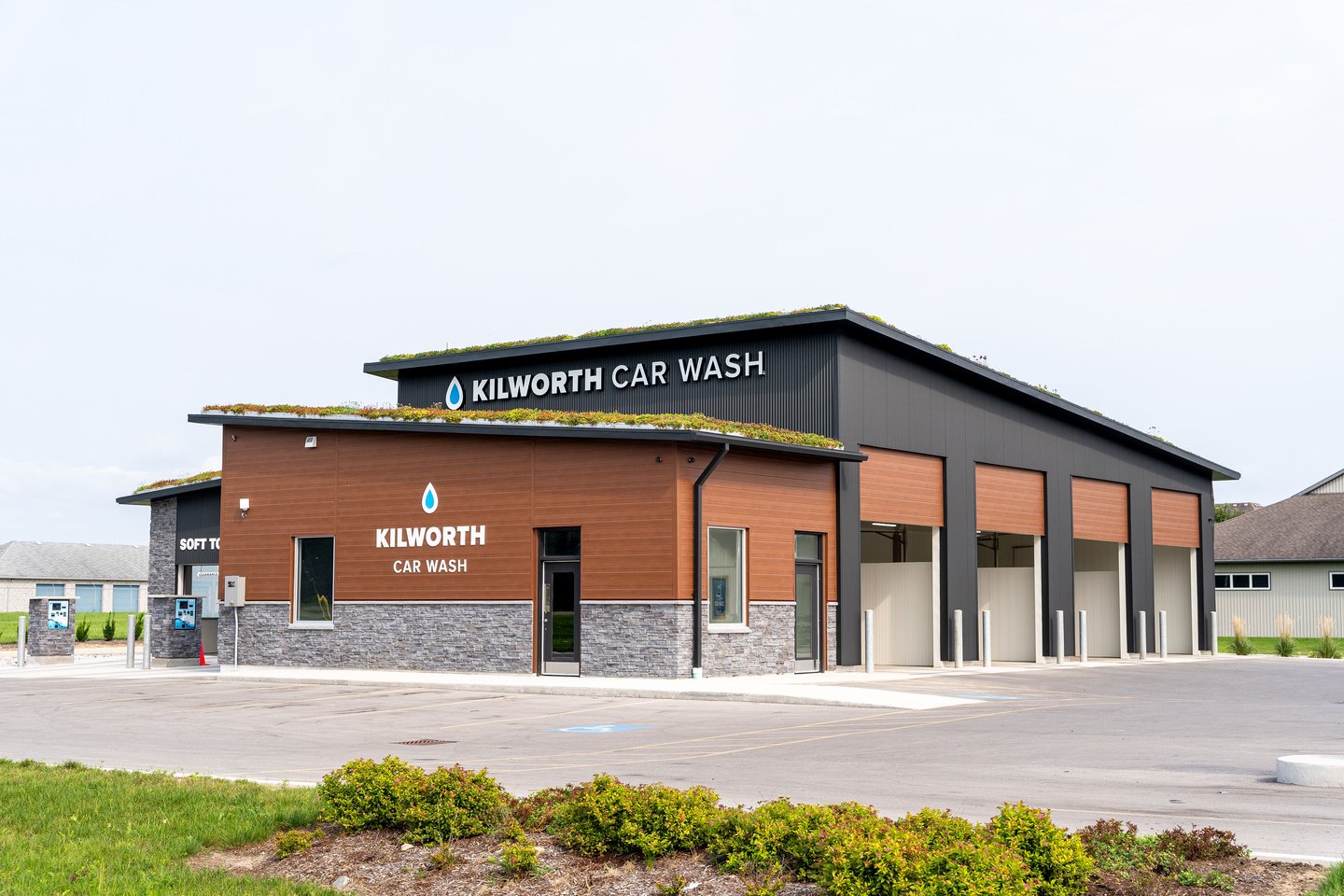 Kilworth Car Wash in Middlesex, Ont. tackles water waste with a state of the art reclamation system, as well as a unique green roof for stormwater.
 -
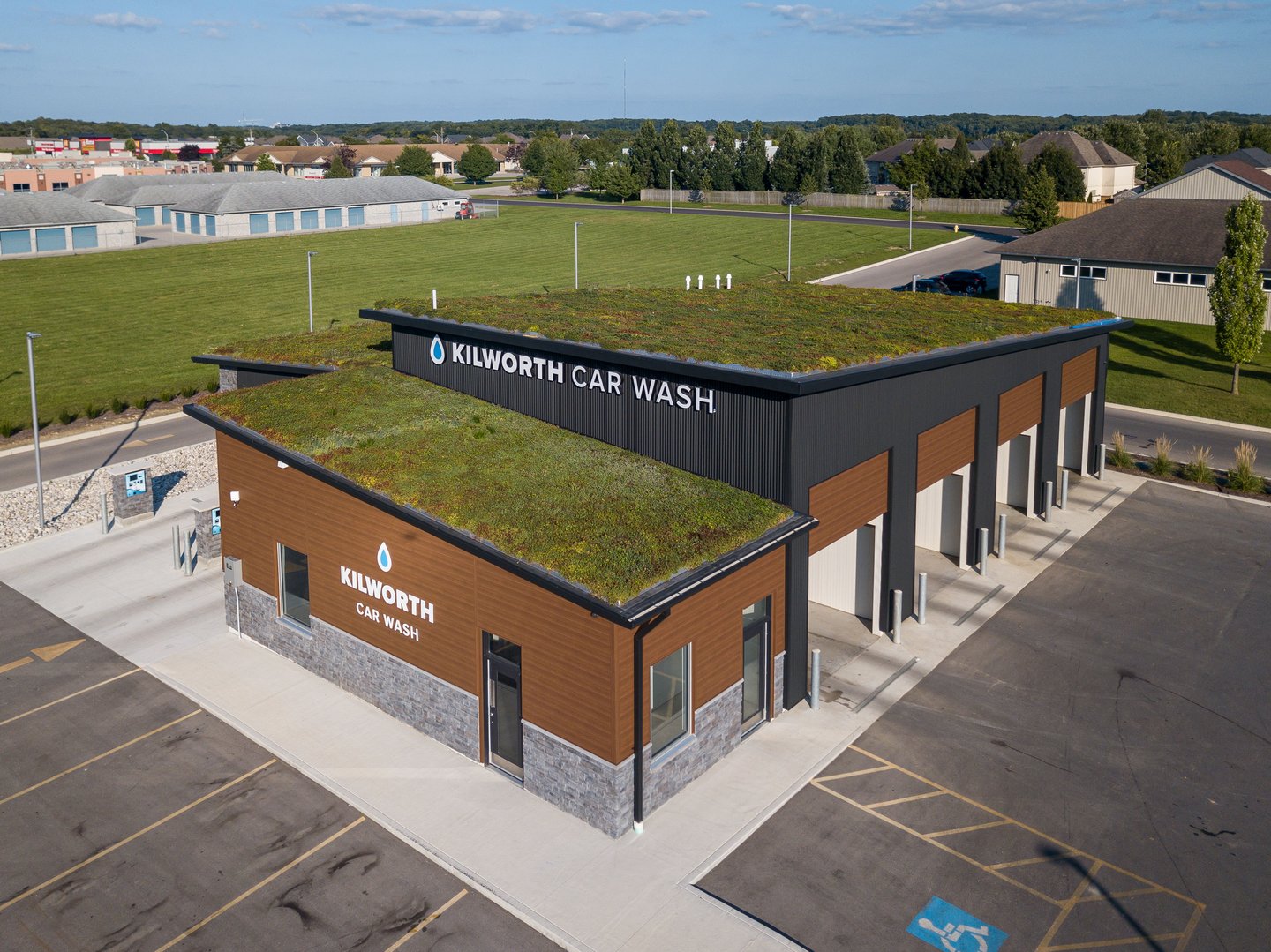 Kilworth Car Wash in Middlesex, Ont. tackles water waste with a state of the art reclamation system, as well as a unique green roof for stormwater.
This article was published in the May/June 2026 issue of Convenience Store News | Octane