Kiwi-based candy puts the “wow” in Kiwow

A heart condition in a newborn son. A 70-year-old ex-colleague who swore by two kiwis a day. Those two events are why there is now a bag of low-sugar fruit chews on shelves in Healthy Planet and Longos.
Kiwow is a better-for-you candy company built around one ingredient: Sun Gold organic kiwi from New Zealand. Founder Merrick Friedberg says the fruit is the whole point of the product, not just a flavour on a label. The company is now looking past the grocery aisle and toward convenience stores and gas stations as its next growth channel.
A family story behind the brand
Friedberg said the idea for Kiwow came from a hard year. His son Keanu, now eight, was diagnosed before birth with truncus arteriosus, a heart defect that meant surgery within his first week of life. The Hospital for Sick Children treated Keanu through that surgery and a second one since and Friedberg credits the hospital for his son's health today.
"He's fine, he'll need more surgeries. He can run and play, but no crazy impacts because he's on blood thinners," Friedberg said.
Around the same time, Friedberg's partner Sandra was searching for a healthy candy option for kids but came back empty-handed. Meanwhile, a 70-year-old former colleague who “rarely got sick,” told Friedberg he ate two kiwis a day because it was one of the few low-glycemic fruits he could find. Friedberg started researching kiwi and landed on the gold variety, which he claims is sweeter and higher in vitamin C than the more common green kiwi.
"We made it [the candy] for Keanu, but also for the diabetics out there."
Kiwow now donates monthly to the SickKids cardiology department, though Friedberg says the company keeps that fact off its packaging for now. Customers who want to learn about the giving can look it up on the company website.
"Giving helps sell a product, but it also gives people a feeling like, ‘you know what, you guys are giving back,’” Friedberg says.
Kiwow's benefits
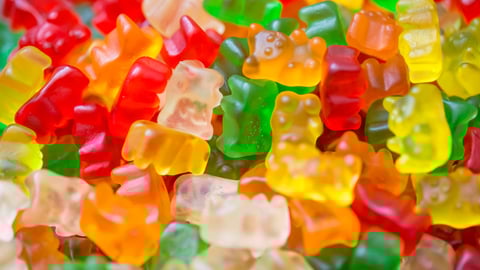
Kiwow makes two products: a fruit chew, which Friedberg compares to a Starburst, made by a co-packer in Ontario and a gummy made by a separate manufacturer in British Columbia. The kiwi arrives at both facilities freeze-dried and ground into a powder. Friedberg adds that his co-packers use a proprietary process that avoids the heavy boiling most candy and gummies go through, which he said helps preserve more of the fruit's nutrients.
The products carry a handful of dietary claims: nut free, tree nut free, gluten free and plant-based, with some items also certified kosher and halal. The gummies, Friedberg said, have four grams of sugar and 14 grams of fibre per 40-gram pack. He positions the gummies against Smart Sweets, arguing Kiwow's version is softer and less likely to stick to the teeth because of the kiwi content.
"We're using super fruit. Smart Sweets is not using super fruit, so you're getting the benefits. You're getting probiotics and vitamin C," Friedberg said.
Building distribution one region at a time
Kiwow's fruit chews and gummies are currently sold at Healthy Planet, Longo's, Nature's Emporium and a handful of independent grocers, including Bruno's, Greco's, Vincenzo's, Summerhill Market and Ambrosia. Friedberg said the company approached larger national distributors early on and was told to prove itself regionally first. That led Kiwow to Cultivar Foods, a small Mississauga-based distributor that Friedberg credits with opening doors to bigger retailers.
For now, the company is deliberately staying focused on Ontario, which Friedberg said accounts for roughly 65 to 70% of consumer packaged goods sold in Canada. National distributor Unify has told the company to keep building a regional track record before expanding further. Friedberg says British Columbia and Alberta are next once that happens. Longer term, he wants Kiwow in Shoppers Drug Mart, which he sees as a natural bridge into the wider convenience channel.
Growth is also coming from outside grocery. Kiwow is moving into the fitness channel with a partnership with GoodLife Fitness, positioning the candy as a low-sugar, no-crash pre-workout snack. Friedberg does much of the on-the-ground marketing himself, running product demos at retailers and events such as the Yorkville Run.
The pitch for convenience stores
Friedberg thinks convenience could become one of Kiwow's biggest channels, but the packaging needs to change first. The fruit chews currently sell in a roughly $4.99 bag, a price point he admits could climb to $5.99 at a gas station once typical retail markups are factored in. To fit the convenience format better, Friedberg is developing a smaller product: a single-serving fruit chew bar, about the size of a credit card, wrapped similarly to a McIntosh toffee bar, in flavours such as strawberry, grape and lemon. He's targeting a price between $1.99 and $2.39.
"That might be our convenience store ticket to get it not only on the shelf but for people to take it because it's under two bucks."
On the merchandising side, Kiwow is still developing floor stands and its gummies currently ship in a tray format similar to Smart Sweets, which Friedberg feels should should translate well to convenience store shelving. Packaging is also getting a refresh: Friedberg says the company is working with a marketing firm to simplify its messaging into a small number of callouts that can communicate the health story without cluttering the bag.
Still a startup, by his own account
Friedberg is candid that Kiwow is not yet a big money-maker. The company is bootstrapped and he expects it will need outside capital soon to keep scaling with its co-packers while protecting margins for distributors and store owners.
"It's a fine balance. At the beginning, as a new startup, it's very challenging," Friedberg says. "We're bootstrapping this ourselves. To be honest with you, we're going to need an influx of capital soon."
For now, the plan is simple: keep proving the brand region by region, starting with the stores that can move the most volume. He'll then let the candy's taste and the sweet story behind it, do the rest.