Ownership vs. hosting your EV charging station

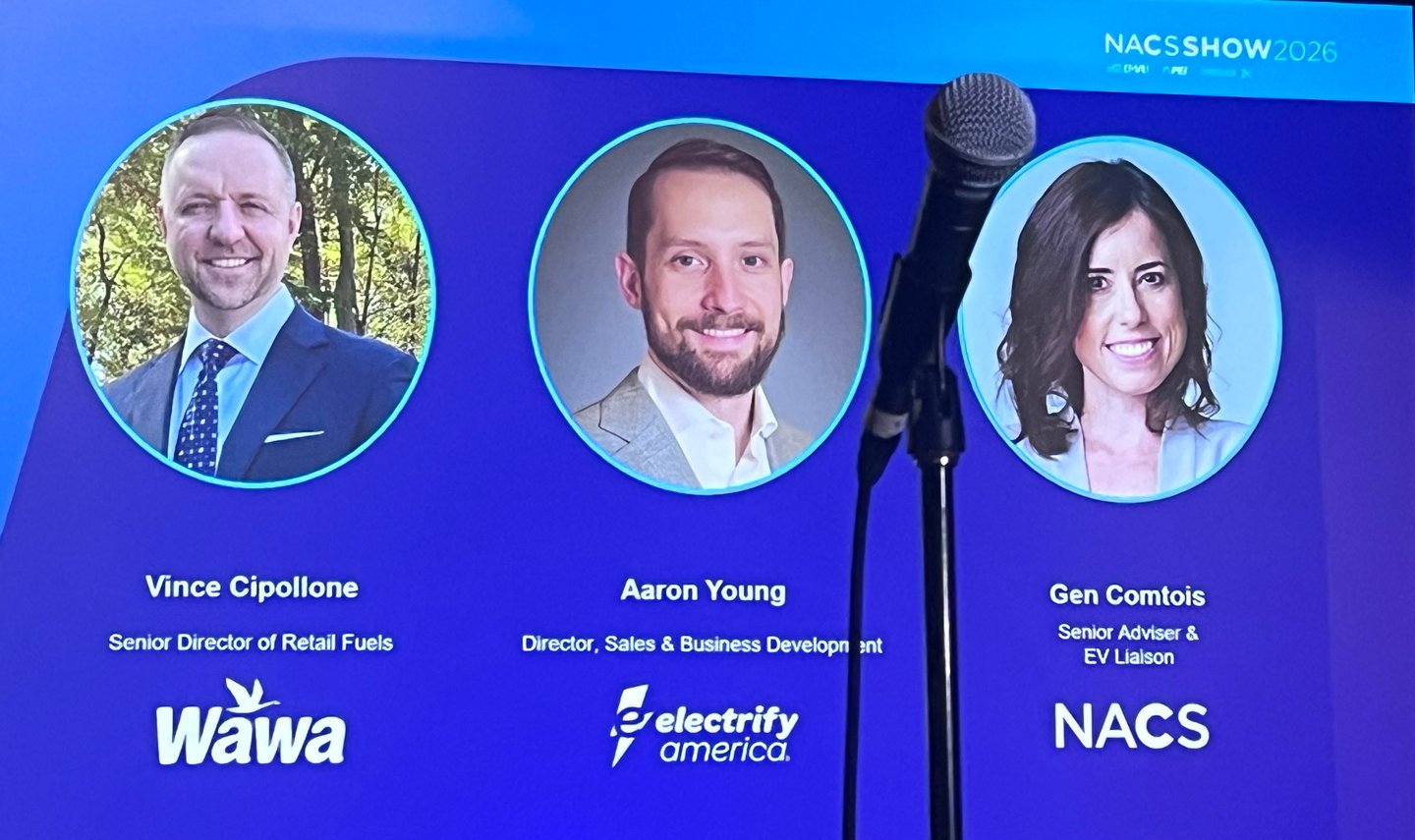
Should your forecourt install a rented EV charging station or buy one to own? At the NACS Show 2026, Gen Comtois moderated a discussion called, “Ownership vs. Hosting: An EV Charging Case Study for Convenience Retailers.”
Vince Cipollone, senior director of retail fuels for Wawa and Aaron Young, the director, sales and business development for Electrify America discussed the strategic integration of EV fast-charging infrastructure into convenience store business models.
The discussion centered on two primary methods for deploying charging infrastructure:
- Site Host Model: A Charge Point Operator (CPO) secures land from a site host (e.g., a retailer). This offers the host predictable income via rent or revenue sharing with minimal risk exposure to asset performance.
- White Label Model: The retailer owns and brands the infrastructure, allowing for full control over the customer experience and 100% of the revenue. However, this requires significant capital investment and carries higher operational risks.
Comptois asked both panelists why retailers should care about EV charging.
Cipollone noted that the harsh reality for liquid fuel retailers is the slow but steady shift to battery electric vehicles. “Last year, around 8% of light-duty sales were for BEV (battery-electric)and it's been at that cadence for a few years now…it did scale back to around 5% last September, but year after year, there's fewer internal combustion engines to serve and as convenience retailers, we want to still capture that trip.”
Cipollone and Young highlighted several critical factors for successful implementation: Beyond direct charging fees, retailers can benefit from incremental in-store sales. “The opportunity, I think, of the incremental sales that you can drive inside and thinking about this like long term is something that is an important lens to put to any of these investment decisions,” recommends Young.
Operational risks
Owning assets introduces high electricity costs, such as peak demand charges and requires managing maintenance and software. Cipollone emphasized the importance of selecting partners with financial stability to weather early market fluctuations. “One of the common denominators is that [EV charging partners] have other revenue streams. They sell vehicles. EA's parent company, Volkswagen, obviously has that to fall back on. Tesla has their offering and they're building the infrastructure to support those sales.”
Young listed some “must-haves” prior to setting up a charger. “You have to be able to have field service technicians. You have to have a supply chain, you have to have a software platform. You have to work with all the different automakers and do integrations, and so you need a lot of scale to be able to operate that.”
Cipollone added "you really need to understand your ownership structure; which sites you lease, which ones you own. You have more flexibility, obviously, when you own the land. You need to get your landlord on board. Depending on the allowances you have in your your master lease, sometimes it's chasing them down, getting consent to install this infrastructure, and how you're going to structure the bills."
Site design key factor to success
Cipollone advised against dedicated EV-only parking to avoid inconveniencing traditional customers, suggesting shared parking instead. He also recommended creative designs to minimize the loss of parking stalls due to equipment placement. "For busy super retailers, parking is a critical asset and a commodity that we're not willing to to give up and the charging equipment needs to fit cleanly behind the curb. If it doesn't and you end up needing to take up parking stalls, that that could be a problem."
Young estimated that if each of Electrify America's 20 million annual sessions resulted in a $7 in-store spend, it would drive $150 million in incremental revenue. He noted that an emerging behaviour can be found in a group of people called “routine users” who charge weekly in public.
“We're seeing customers who don't have access to home charging have to go out and charge somewhere. And when people charge for 30 minutes, they typically want something to do.”
Implementation lessons
The participants shared insights gained from real-world deployments: Cipollone described a collaborative process with Electrify America to launch six live sites, noting that a partner must be able to support technical needs like integrating both CCS and NACS connectors. At this stage, neither domestic vehicles or charging sites have the capacity for superchargers. However, that doesn’t present an obstacle to standard charging and the revenue it generates.
"It's more than just positive cash flow that you're after," cautioned Cipollone. "You're looking for an efficient use of your capital dollars. Would investing in those chargers be a better investment than building more stores and other offers that that's part of your business? Consider that closely."
READ: Canada makes more investments to support zero-emissions vehicles
Both speakers emphasized leveraging grants to offset high capital costs. Young stressed that achieving profitability in charging requires significant scale to amortize fixed costs. In Canada, grants like ZEVIP, ChargeON and Green Economy Canada EV Charger Incentive Program can help alleviate some of the costs associated with installation, but Young had some reservations.
“Incentives are great, but they come with strings attached and they can typically elongate the process. So they can take a project that's already 12 months and make it 18 months or potentially longer because there's additional approvals involved,” he cautioned.
EV charging requires long-term vision
Because vehicle turnover takes years, retailers should view charging as a long-term play to capture emerging "routine users" who lack home charging access. As EV drivers often build charging into their weekly routine, they are loyal to their location.
Young advised “a high percentage of customers who drive electric wouldn't be visiting these stores if not for having charging there. If they made the purchase there, they'd say they wouldn't have made that purchase had they not had they not been on site to charge. So it is definitely driving some incremental behaviour, and that's something that the retailers can really capture.”
Both panelists noted that if the location is unclean or offers friction through transactions or in-store experience, the customers will change stores and take EV charging business along with them. While speed of chargers were a factor, having more availability is key. Young's end note was on the rapid adoption of EV and that retailers should be ready. "I think we know that when this technology is ready, it is going to be adopted really quickly."
- CONSIDERATIONS
- Be creative in your design approach: Minimize any stall reduction behind the curb when you can. If the power cabinets or feed from the transformer means eliminating a stall, can you offset it elsewhere? Adjust the widths of your parking and perimeter stalls.
- Pick your sites well: fully understand the utility costs before you get into installing charging stations at a location.
- Who you partner with is critically important.You need a partner that has the financial wherewithal to weather some early storms financially.
- Funding is available: Natural Resources Canada offers ZEVIP, (Zero-emission vehicle infrastructure funding.) There is also the EV ChargeON program, which requires that charging stations must be hard-wired, certified for use in Canada, and completely operational for a minimum commitment of 5 years.