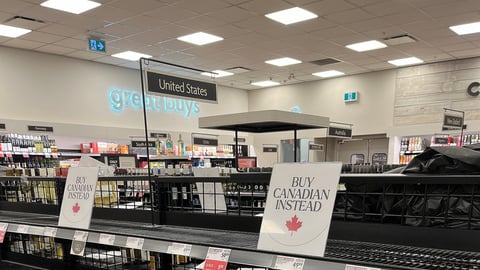
Buy Canadian c-store strategy: How retailers turn local demand into profit


Canada’s “Elbows Up” sentiment has matured from an emotional burst of national pride into an actionable consumer habit. Driven by shifting trade dynamics, tariffs and domestic supply chain shortcomings, Canadians are intentionally spending closer to home.
For convenience store operators, fuel retailers and consumer packaged goods (CPG) suppliers, this shift presents both an operational dilemma and a margin-building opportunity. While customer sentiment heavily favours domestic goods, convenience retail is ultimately governed by two non-negotiables: Speed and price. Translating patriotic intent into basket size requires understanding the data, refining in-store merchandising, clarifying domestic claims and aligning procurement strategies.
Consumer sentiment vs. register reality
The gap between what shoppers say in surveys and what they scan at checkout is narrowing when clear visual cues remove friction.
The 2026 C-store IQ National Shopper Study: Sustainability + Buy Local Report revealed that Canadians are buying local: 59% of shoppers who say they “always” or “often” buy local, do it to support the Canadian Economy and 41% buy Canadian products to protest U.S. trade actions or tariffs.
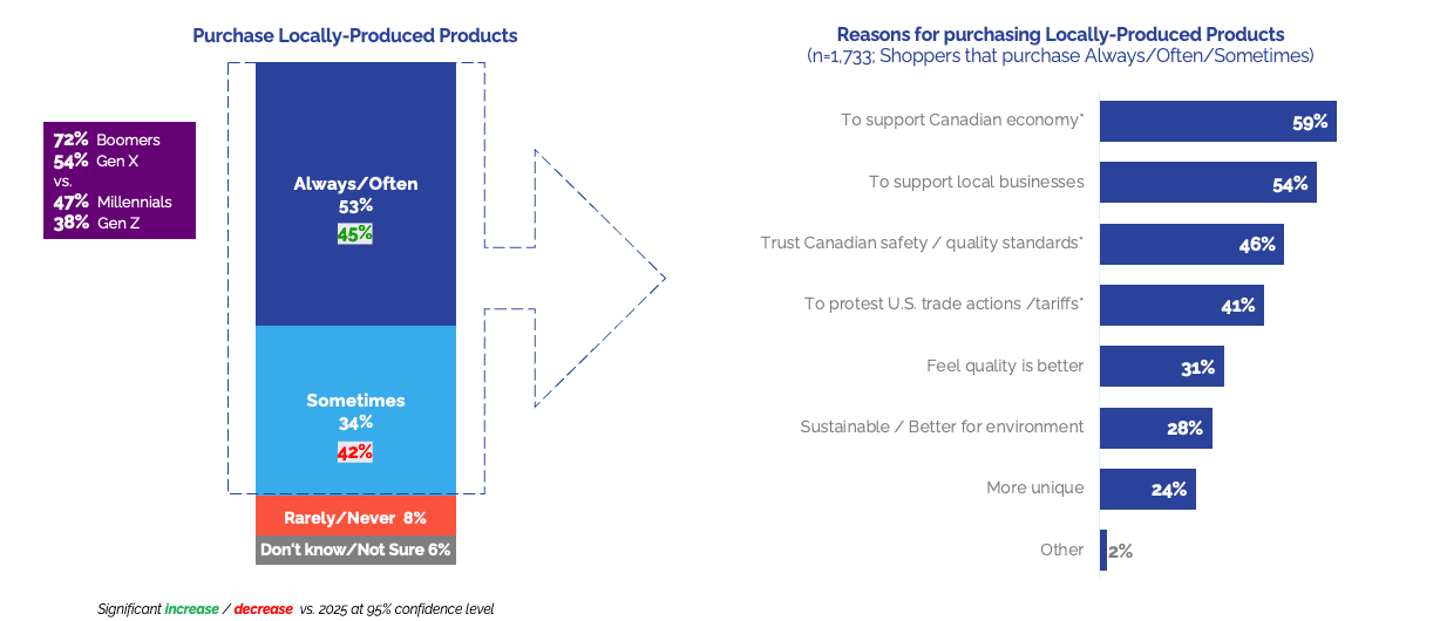

As the report points out, “The results point to a clear shift: more than one-third of shoppers (36%) say they are deliberately buying more Canadian-made products than a year ago, while 27% are consciously purchasing fewer U.S.-made items.
“This trend reflects a growing emphasis on supporting domestic products, influenced by economic, cultural and trade considerations—and presents a meaningful merchandising opportunity for operators.”
Shoppers are actively scanning shelves for hometown alternatives, yet they make purchasing decisions in seconds. Merchandising must bridge this gap through low-friction visual touchpoints.
Because convenience shopping hinges on immediacy, operators cannot expect customers to spend minutes scrutinizing fine print on product backs. Domestic products must be flagged immediately across forecourts and aisles.
Dynamic out-of-home (DOOH) targeting
On the forecourt and above the counter, digital screens can tell hyper-local stories that connect directly with nearby shoppers and seasonal travellers. Scott Mitchell, managing director for Canada at Vistar Media, emphasizes the agility modern DOOH networks offer convenience and fuel retailers:
"It's really about working closely with those partners to help them add the nuances to the Canadian market... A huge benefit for out-of-home is really understanding the physical placements and the immediate environment. Because we can deliver in next-to-real time, it gives us the flexibility to adapt messages on the fly—serving one creative execution on a convenience store counter screen and a distinct call-to-action on a fuel pump display."
This responsiveness allows operators to broadcast real-time limited-time offers (LTOs), feature weekend craft brew arrivals or promote seasonal regional snacks to cottages and commuter routes.
Subtle shelf-level execution
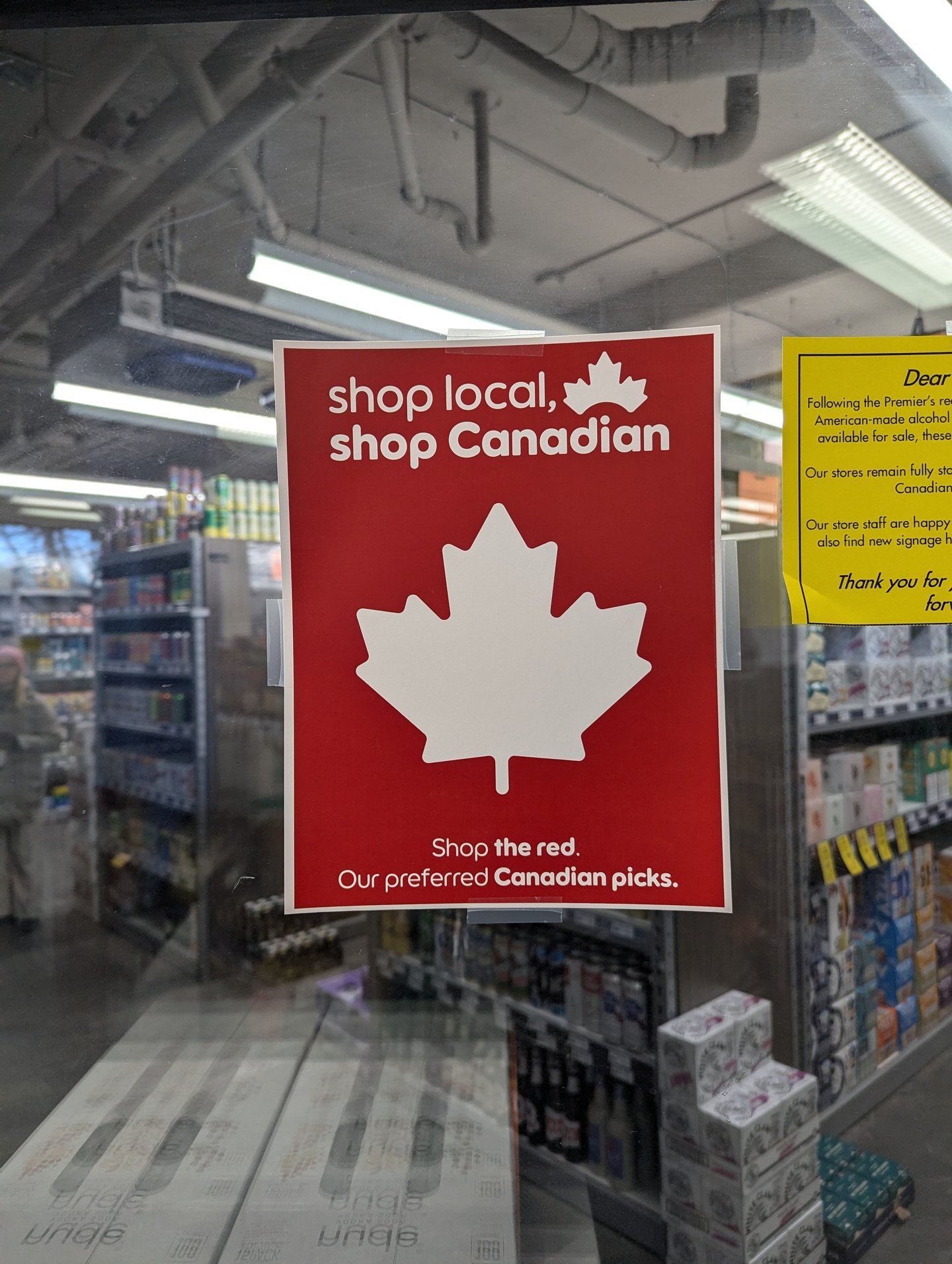
Inside the store, small, recognizable visual cues consistently outperform aggressive flag-waving. Simple shelf-talkers, maple leaf stickers and dedicated local chillers reduce friction at the point of decision.
Sarayu Kandregula, key account manager and convenience channel lead at Carlsberg Canada, notes that domestic branding delivers measurable lift when kept clean and direct: "Our Laker value brand—an Ontario staple—has certainly benefited from this movement, showing unprecedented growth. Consumers are vocal in asking for these products. The most effective in-store execution I've seen remains communicating clearly right on the shelf; a simple maple leaf sticker makes it effortless for shoppers to spot."
Sasha Teska, key account and trade development manager at Southern Glazer’s Wine and Spirits, confirms that this dynamic is especially pronounced in licensed categories:
"Canadians wear supporting domestic products as a badge of pride. We see this across VQA wines, Ontario craft beers and ready-to-drink (RTD) cocktails. Brands like Iceberg Vodka or Collective Arts feature subtle logos and identifiers that let the product sell itself. You don't want to overwhelm shoppers with overt flag-bearing; subtle, organized signals help the hurried shopper make that final, proud decision—and often justify a slight price premium."

Impulse and emergency purchases: Expanding the basket
The domestic halo is not limited to cold vaults and snack aisles; it increasingly extends to immediate-need non-food categories.
Convenience stores serve as critical access points for wellness and personal care. While consumers rely on familiar over-the-counter staples, clear domestic manufacturing credentials reinforce brand trust during high-urgency stops. Pairing routine emergency purchases with recognizable domestic labels gives shoppers an added reason to complete their transactions locally rather than waiting for big-box or digital orders.
Recognizable certification marks also provide instant reassurance. The Dairy Farmers of Canada's Blue Cow Quality Milk logo—recognized and trusted by 9 out of 10 Canadians according to research from IMI International—demonstrates that authenticated origin stamps drive decisive shopper behaviour across daily essentials.
“Convenience is playing a more meaningful role for customers because they're accessing our products across channels that we never imagined would be channels, including online,” says Sarey Wulf, the head or corporate affairs. for Haleon Canada, a consumer healthcare company that produces everything from toothpaste to over-the-counter medications. “For the convenience store aspect, people still like to go in and grab a pack of Advil when they're popping in to get a pack of gum. So I think it's a really important channel when we think about convenience for our Canadian consumers and their need to continue to practice self care.”

Navigating the nuances of “Made in Canada”
For multinational brands operating in Canada, the growing emphasis on buying Canadian presents both an opportunity and a communications challenge. What does it really mean to be Canadian? Is it where a product is manufactured, where ingredients are sourced, who owns the business or the local communities it supports? For global brands, the answer is rarely straightforward—and the distinction matters as consumers become more conscious of where their dollars go.
The Coca-Cola system in Canada offers a clear illustration. While Coca-Cola is an iconic American-born brand, Coca-Cola Canada Bottling is a Canadian, family-owned business deeply rooted in local communities. Its domestic manufacturing, distribution, workforce and investments form a key part of its story.
Similarly, PepsiCo Canada’s “Rooted in Canada” initiative (which won a 2026 CSNC Impact Award) partnered with Canadian farmers to highlight the domestic agricultural relationships and local supply chain behind its products. This four‑phase program empowered employees to become confident “Made in Canada” ambassadors by equipping teams with farming and manufacturing stories, as well as real‑world tools, so they could proudly share PepsiCo’s local impact with their customers and communities. By spotlighting manufacturing, farming and front-line teams, the program enabled employees across food and beverage sectors to actively represent the origins of their products and build trusted connections.
These examples show that a multinational brand can maintain a strong Canadian identity and economic footprint, even if its parent company is headquartered elsewhere.
For retailers, understanding these distinctions is essential. Customers may seek Canadian-made items, Canadian-owned businesses or products that support local farmers and suppliers—and those are not always the same thing.
Understanding the ownership, manufacturing and sourcing stories behind shelf products allows retailers to communicate clearly and help shoppers make informed decisions.
Recognizing these details helps retailers build customer trust and recognize the broader economic contributions brands make locally.
READ: United we win, divided we fall
Range of label claims for Canadian-made products
To prevent “maple-washing” claims and maintain consumer trust, convenience buyers and category managers must understand how regulatory bodies define domestic products.
Beyond homegrown staples, many multinational brands offer a middle tier. Because their imported ingredients are processed and packaged locally, these beverages fall under the official category “Made in Canada from domestic and imported ingredients.”
Label Claim | Requirement / Standard | Convenience Store Application |
"Product of Canada" | 98% or more of the total direct costs of producing/manufacturing the product were incurred in Canada. | Reserved for items where active ingredients and processing are almost entirely domestic. Ideal for premium positioning. |
"Made in Canada" (with qualifying statement) | At least 51% of total direct production costs are Canadian and the last substantial transformation occurred in Canada. Must include a qualifier (e.g., "Made in Canada with imported ingredients"). | Common for pharmaceutical and OTC brands where raw ingredients are imported, but mixing, assembling and packaging occur domestically. |
Brand Heritage / "Canadian Brand" | Identifies companies founded in Canada or headquartered domestically (e.g., W.K. Buckley Limited founded in Toronto), regardless of where specific ingredients are sourced. | Helps c-stores build trust by relying on familiar, heritage-brand recognition. |

Opportunities for private label
Given how chains like Couche-Tard /Circle K and 7-Eleven invest in proprietary product lines, how can convenience chains leverage Canadian sourcing in their private-label tier to build margin and local trust simultaneously? CSNC asked Lisa Hutcheson, managing partner of J.C. Williams Group how Canadian c-stores can strike the right balance between cost and authentic hometown appeal.
“Canadian-sourced private label offers larger c-store chains a rare combination of margin improvement and genuine brand differentiation, filling a gap that operators like Couche-Tard have historically left open relative to grocery players like Loblaw or Sobeys,” said Hutcheson.
“For chains with the procurement scale to pursue it, the opportunity is most flexible in fresh and foodservice, where local sourcing arrangements are operationally manageable and even a single anchor product (a coffee blend, a breakfast sandwich, a regional bakery item) can anchor a credible Canadian-identity story while directly challenging the quality perception gap that has long shadowed convenience retail."
The long-term horizon: Quality outlasts slogans
While current geopolitical tensions have spotlighted economic patriotism, successful retailers design their planograms around sustained customer value, not fleeting headlines.
Dominick Miserandino, CEO of RTMnexus, notes that c-store trips are fundamentally driven by immediacy:
"Convenience shoppers run on impulse and instant gratification. They enter for an immediate need at an accessible price point. While consumers may appreciate a Canadian tag and pay a modest premium for the feel-good factor, price and availability remain the final arbiters at the register."
Ryan Klein, vice-president of development for Greenhouse says that he’s seen the “Buy Canadian” movement come and go in waves and that a shopper wants a particular product, patriotism isn’t going to be a main driver. “We're seeing it come back a little more. I think it's definitely important, but I don't think it's the only choice. I think consumers are going to buy based on product quality.”
Looking ahead, Hutcheson cautions against relying exclusively on patriotic merchandising:
"The acute intensity of the 2025 tariff and trade wave was ignited by immediate political friction. That sharp urgency naturally normalizes. Shoppers who spent early 2025 scrutinizing origin marks on a salty snack will not sustain that deliberate friction indefinitely. Convenience retail always reverts to its core fundamentals: speed, location and fair value."
For convenience operators, the strategy is clear: use the current "Buy Canadian" momentum to introduce, test and spotlight high-margin domestic items. The products that earn a permanent place on the planogram, however, will be those that pair domestic origins with genuine quality, sharp price architecture and frictionless in-store visibility.