Corby's Q1 fiscal 2027: RTD beverages drive growth as spirits face market pressure


Canadian convenience store operators selling alcohol have a clear takeaway from Corby’s latest financial update: Ready-to-drink (RTD) beverages remain a major growth engine even as traditional spirits face a tougher retail environment.
Speaking during the company’s first-quarter fiscal 2027 conference call, Florence Tresarrieu, president and chief executive officer highlighted shifting consumer habits, ongoing changes to retail access in Ontario and intense price competition on store shelves. While the company’s overall reported revenue fell 4% to $72.5 million following the August 2026 sale of the Lamb’s rum brand, organic revenue grew 1%. That gain came against a tough comparison from the prior year, when organic revenue jumped 16%.
Adjusted earnings from operations rose 15% to $18.9 million, while adjusted earnings per share increased 18% to 46 cents. Reported earnings per share climbed 171% to 97 cents, boosted by a one-time gain from a land sale.
RTD brands gain market share across Canada
For retailers looking to optimize cooler space, RTD beverages continue to show strong momentum. Corby’s ready-to-drink volume rose 3.8% over the latest six months, pushing the company’s national market share in the category to 10%. Over a rolling 12-month period, Corby’s ready-to-drink portfolio grew 7.7%, outperforming the broader category by five percentage points.
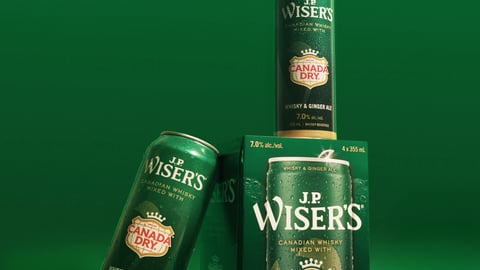
Tressarieu noted, “nationally, Corby RTD volume grew plus 3.8% in the last six months and achieved a market share of 10%. Cottage Springs maintains its position as the number one RTD brand in Ontario, while Ace Beverage Group continues to deliver strong momentum in Western Canada.” New releases, namely, Cottage Springs and J.P. Wiser’s Canada Dry stood out among top innovations in Ontario, showing how quickly shoppers respond to fresh flavours.
READ: Corby Spirit and Wine extends production partnership with Hiram Walker to 2031
Ontario retail modernization shapes alcohol sales
Changes in how alcohol reaches consumers remain a major focus for Corby, especially in Ontario. Chief financial officer Juan Alonso noted that the company plans to keep capitalizing on route-to-market modernization in the province while adapting to softer store traffic at traditional spirits retailers. The company aims to do this by “meeting evolving consumer preferences with agility and breadth, taking an agile approach to navigate softer spirits retailers start traffic and pricing pressure from the removal of the minimum pricing,” said Alonso.
Domestic goods accounted for 82% of Corby’s first-quarter net sales, reaching $59.4 million. While reported domestic revenue dipped 3%, organic domestic revenue rose by 3%, helped by RTD growth and price gains from market changes in Ontario and Alberta. Commissions made up 12% of net sales at $9 million, up 10% from a year earlier thanks to new partner commissions and higher agency fees.
Tracking exact provincial market share has come with a temporary delay. Complete first-quarter Ontario market data was unavailable when Corby reported its results. According to a Nov. 6, 2026 update from the Liquor Control Board of Ontario, retail data covering April 1 through Aug. 15 is being republished to fix discrepancies, with corrected figures expected by the end of December 2026.
Spirits face heavy vodka promotions and tough comparisons
While coolers and canned cocktails thrive, traditional spirits are navigating slower demand. Over the three months ending Aug. 31, 2026, the broader Canadian spirits market declined 3.7%, while Corby’s spirits portfolio fell 6%.
Alonso noted that several factors are weighing on the category. Retailers and suppliers have ramped up promotional activity in vodka, creating sharp price competition. Meanwhile, Canadian whisky sales are seeing a dip from the previous year sparked by the removal of U.S. products from store shelves. Even with the recent decline in sales, Corby outperformed the broader spirits market over the rolling 12-month period across Canadian whisky, tequila, vodka and rum.
During the question-and-answer session, analysts asked how Corby plans to handle underperformance in its Polar Ice vodka brand. Tresarrieu said restoring volume growth or improving the brand’s trajectory is a “top priority” while protecting profit margins. Alonso added that Corby manages its brands as a total portfolio, using strong margin improvements in ready-to-drink beverages to help balance competitive pricing moves in spirits when needed.
What c-stores can expect next
Looking ahead to the rest of fiscal 2027, Corby expects earnings growth to align more closely with revenue growth after strong margin comparisons in the first quarter. Total operating expenses fell 7% in the quarter, helping lift adjusted net earnings well ahead of top-line sales.
Backed by $7.4 million in operating cash flow, a net debt to adjusted EBITDA ratio of 0.8 times after accounting for an $18.7-million representation agreement fee paid on Oct. 1, 2026, and a nine % dividend increase to 25 cents per share, the company plans to stay disciplined on costs while investing behind high-growth categories. For convenience store offering liquor, that means continued marketing support, new RTD product launches and aggressive competition for shelf and cooler space across Canada.
Alonso concluded, “Corby is well positioned to continue driving earnings growth and delivering shareholder returns, despite facing a more challenging comparison based on following its strong performance in FY '26.”